Stainless steel, carbon steel and spring steel coils and strips, with duplex, nickel alloys,
titanium, copper, brass and aluminium — and the grades, tempers, coil weights, edges and
tolerances you need to specify them.
Product Overview
Wound, Slit and Ready to Feed
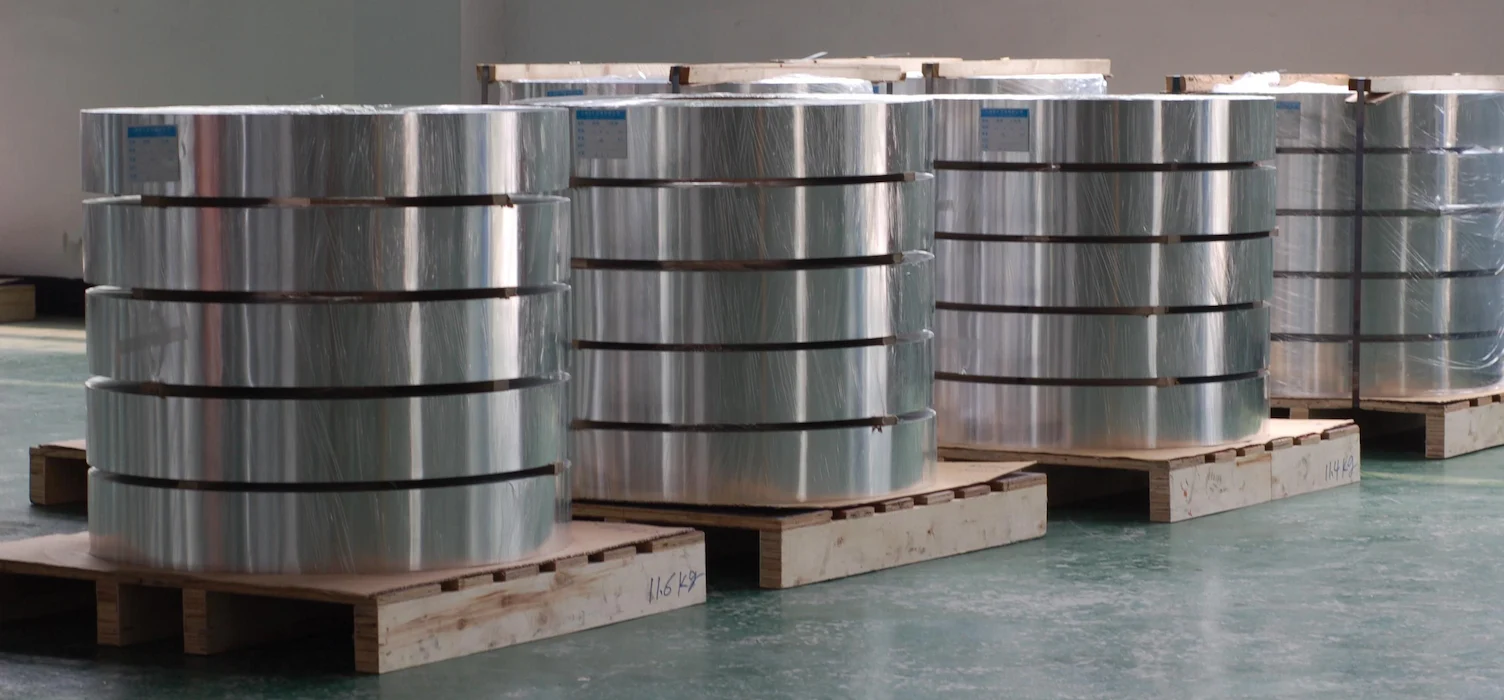
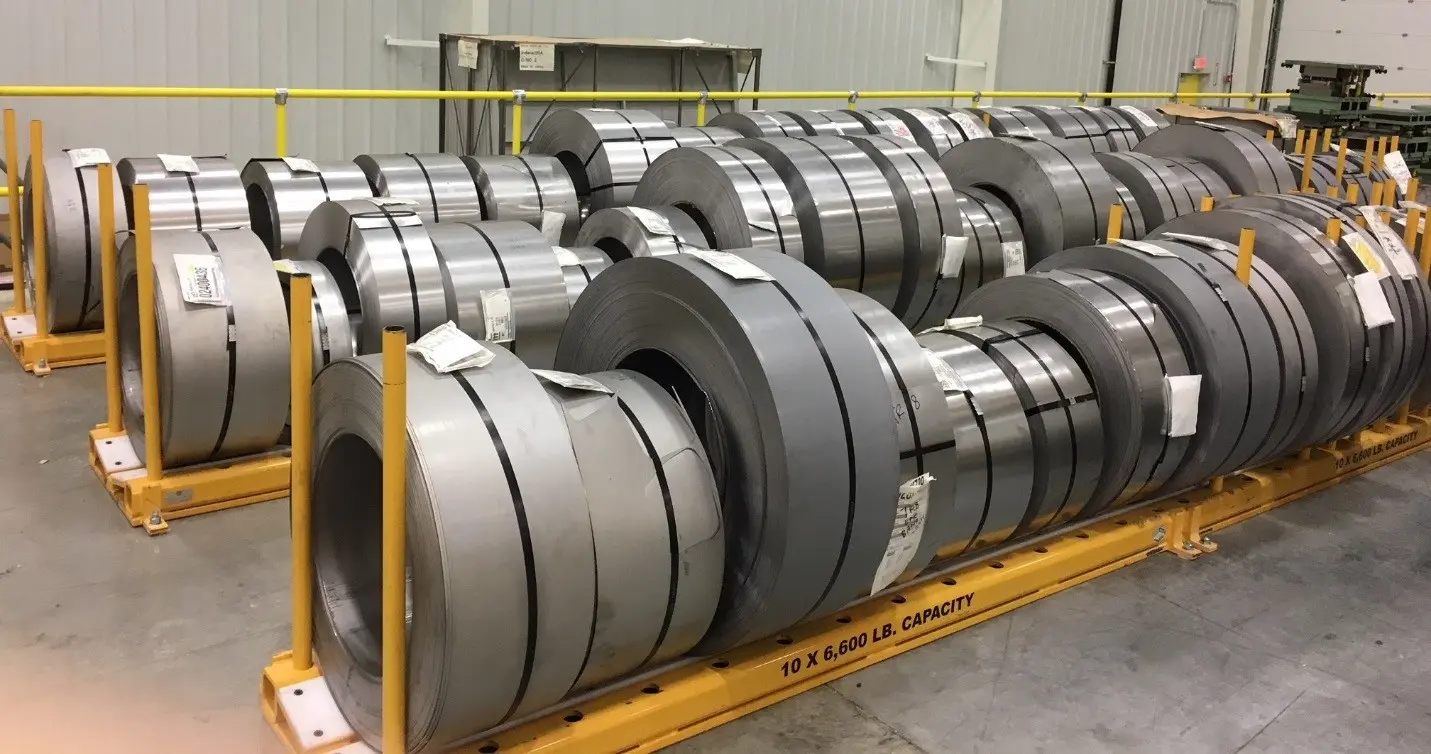
We supply hot rolled coils, cold rolled coils, slit coils and strips, and precision
strip in stainless steel, carbon steel and spring steel — and in duplex, high nickel
alloys, titanium, copper, brass and aluminium when the application calls for them.
Coils are supplied at full mill width, slit to the widths your press or tube mill needs, or cut
to length. Every coil carries its heat or coil number and is supplied with a mill test certificate
to EN 10204 Type 3.1 or 3.2. When your project needs independent verification, inspection by your
nominated agency is carried out before dispatch.
Thickness and width describe the strip. Inside diameter, outside diameter and weight describe how it is wound, and decide whether the coil fits your uncoiler.
End view (left), side view (centre) and a magnified view of three wraps of strip (right).
Thickness
The strip itself, in mm. Thin cold rolled strip is also described by gauge; state the thickness in mm to avoid confusion.
Width
Mill coils come in standard widths such as 1000, 1219, 1250 and 1500 mm. Anything narrower is slit from a wider coil.
Inside diameter (ID)
Must fit the mandrel of your uncoiler. 508 mm (20") and 610 mm (24") are the usual sizes.
Outside diameter (OD) & weight
Set by how much strip is wound. Give the largest OD or coil weight your line and crane can handle.
Coil, strip or foil? A coil is flat-rolled metal wound into a roll. For stainless steel, ASTM A480 calls material under 5 mm thick and under 600 mm wide strip. Very thin strip, usually under about 0.2 mm, is called foil.
Types
Four Kinds of Coil, One Supplier
How the coil is rolled and cut decides its thickness range, surface and tolerance, and so what it is used for.
Hot Rolled Coils
Rolled from slab at high temperature and wound hot. The heavier gauges, with a scaled or pickled surface.
Best for
Tube making, structural forming, and feedstock for cold rolling
Typical specifications
A240 · IS 2062 · A1011 · EN 10111
Cold Rolled Coils
Hot rolled coil rolled again at room temperature, for thinner gauges, a smooth surface and close tolerance.
Best for
Appliances, kitchenware, panels, pressed and drawn parts
Typical specifications
A240 · A1008 · IS 513 · EN 10130
Slit Coils & Strips
A wide coil cut lengthwise into narrow coils, to the exact widths your press, roll former or tube mill takes.
Best for
Tube mills, roll forming, stamping and press feeding
Tell us
Width, width tolerance, edge, coil ID and maximum OD
Precision Strip & Foil
Thin cold rolled strip held to tight thickness tolerance, often in a hard temper for springs and stampings.
Best for
Springs, clips, shims, gaskets, electrical and electronic parts
Typical specifications
A666 · EN 10151 · EN 10132 · B103
Supply Formats
From Mill Coil to the Size You Need
A coil can be supplied at any point along this route: at full mill width, slit into narrow coils, or cut into sheets and blanks.
Mill coil
Full-width hot or cold rolled coil, as it leaves the rolling mill.
Slitting
Rotary knives cut the coil lengthwise into narrow coils, each wound to the width you need.
Cut to length
The strip is levelled flat and sheared into sheets or blanks of a fixed length.
Packing
Strapped, wrapped against moisture and packed eye-to-sky or eye-to-wall on pallets or skids.
Materials & Grades
Every Grade, in Coil and Strip Form
Choose a material family to see the grades we supply, their international designations, and the specifications that cover coil and strip.
Stainless Steel Coils & Strips
The 300 series covers most process and food-grade work. The 200 series is the economical choice for kitchenware and tubing, 301 is rolled hard for springs, and the ferritic 400 series serves exhausts and appliances.
Coil, sheet & strip
ASTM A240 · ASME SA240
Cold-worked tempers
ASTM A666 · EN 10151
European & Japanese
EN 10088-2 · JIS G4305
Grade
UNS
EN / W.Nr.
Where it is used
201
S20100
1.4372
Manganese-bearing, low-nickel grade — kitchenware, utensils and decorative tube.
202
S20200
1.4373
Similar to 201 with more manganese — hardware and decorative work.
301
S30100
1.4310
Work-hardens strongly — springs, clips and structural parts in hard tempers.
304 / 304L
S30400 / S30403
1.4301 / 1.4307
The general-purpose grade — sinks, food equipment, tube making and pressings.
316 / 316L
S31600 / S31603
1.4401 / 1.4404
Chloride and chemical service; pharmaceutical and coastal applications.
321
S32100
1.4541
Titanium-stabilised — expansion bellows and exhaust components.
309S / 310S
S30908 / S31008
1.4833 / 1.4845
Heat-resisting grades — furnace parts and heat shields.
Ferritic and magnetic — appliances, trim and interior panels.
441
S43940
1.4509
Dual-stabilised ferritic — hot end of exhausts and heat-exchanger parts.
410
S41000
1.4006
Martensitic and hardenable — blades and wear parts.
Duplex & Super Duplex Coils & Strips
Twice the yield strength of 316L with far better resistance to chloride stress-corrosion cracking. Duplex coil is the feedstock for welded duplex tube and thin-walled tanks.
Coil, sheet & strip
ASTM A240 · ASME SA240
European
EN 10088-2
Corrosion tests
ASTM A923 · ASTM G48
Grade
UNS
EN / W.Nr.
Where it is used
Lean Duplex 2101
S32101
1.4162
Tanks and structures where higher strength than 304 saves weight.
Lean Duplex 2304
S32304
1.4362
Molybdenum-free duplex with corrosion resistance close to 316L.
Duplex 2205
S31803 / S32205
1.4462
Welded tube, chemical tankers and desalination equipment.
Super Duplex 2507
S32750
1.4410
Seawater systems and high-chloride process plant.
Carbon Steel Coils & Strips
Hot rolled coil is chosen for strength and economy; cold rolled coil for surface, flatness and formability. Drawing grades are graded by how deep a part they can form.
Hot rolled coil
IS 2062 · ASTM A1011 · EN 10111
Cold rolled coil
IS 513 · ASTM A1008 · EN 10130
Carbon steel strip
ASTM A109 · SAE J403
Specification & grade
Product
Where it is used
IS 2062 E250 / E350
Hot rolled coil
Structural sections, tube and pipe making, general fabrication.
ASTM A1011 CS / SS
Hot rolled coil
Commercial and structural hot rolled sheet and strip.
EN 10111 DD11 – DD14
Hot rolled coil
Low-carbon steel for cold forming, from simple bends to deep drawing.
IS 513
Cold rolled coil
Cold rolled sheet and strip in commercial, drawing and deep-drawing qualities.
ASTM A1008 CS / DS
Cold rolled coil
Commercial and drawing steel for pressed parts and panels.
EN 10130 DC01 – DC04
Cold rolled coil
Cold forming steel, from DC01 for bending to DC04 for deep drawing.
SAE 1008 / 1010
Cold rolled strip
Low-carbon strip for stampings, tubing and general engineering.
Spring & Alloy Steel Strips
High-carbon and alloy strip is hardened and tempered, or supplied annealed for the customer to form and heat-treat. It is the material of flat springs, blades and washers.
Spring steel strip
EN 10132-4 · SAE J403
Alloy steel strip
SAE J404 · AMS 6350
Supply condition
Annealed · hardened & tempered
Grade
Equivalent
Type
Where it is used
C75S
SAE 1075 · 1.1248
Carbon spring steel
Flat springs, clips, washers and saw blades.
C100S
SAE 1095 · 1.1274
High-carbon spring steel
Knife blades, cutting tools and highly stressed springs.
51CrV4
SAE 6150 · 1.8159
Chromium-vanadium spring steel
Heavy-duty springs and parts under fatigue loading.
AISI 4130
AMS 6350 · 1.7218
Chromium-molybdenum alloy
High-strength formed and welded parts.
High Nickel Alloy Coils & Strips
Inconel, Incoloy, Monel and Hastelloy strip is used for bellows, gaskets, heat shields and thin-walled components where stainless steel is not enough. The ASTM specifications cover plate, sheet and strip together.
Alloy
UNS
W.Nr.
Sheet & strip
Where it is used
Nickel 200 / 201
N02200 / N02201
2.4066 / 2.4068
B162
Battery, electronic and caustic-service components.
Monel 400
N04400
2.4360
B127
Seawater and hydrofluoric acid service.
Inconel 600
N06600
2.4816
B168
Heat-treatment fixtures and furnace parts.
Inconel 625
N06625
2.4856
B443
Bellows, expansion joints and flue-gas components.
Incoloy 800 / 800H / 800HT
N08800 / N08810 / N08811
1.4876 / 1.4958 / 1.4959
B409
Heat-exchanger and furnace components.
Incoloy 825
N08825
2.4858
B424
Acid-resistant liners and components.
Hastelloy C276
N10276
2.4819
B575
Chemical-process and scrubber components.
Alloy 20
N08020
2.4660
B463
Sulphuric acid handling.
Titanium Coils & Strips
Commercially pure titanium strip is the material of plate heat exchangers and welded condenser tube. Grade 5 is the high-strength alloy.
Strip, sheet & plate
ASTM B265 · ASME SB265
Density
4.51 g/cm³
Condition
Annealed
Grade
UNS
Type
Where it is used
Grade 1
R50250
Commercially pure
The most formable grade — heat-exchanger plates.
Grade 2
R50400
Commercially pure
General corrosion service and welded tube.
Grade 5
R56400
Ti – 6Al – 4V
High-strength aerospace and engineered parts.
Grade 7
R52400
Ti – 0.15Pd
Palladium-bearing, for reducing acids.
Copper & Brass Coils & Strips
Copper strip carries current and heat; brass and bronze strip is stamped into terminals, connectors and springs.
Copper
ASTM B152
Brass & bronze
ASTM B36 · B103
Copper-nickel & beryllium copper
ASTM B122 · B194
Alloy
UNS
Specification
Where it is used
ETP Copper
C11000
B152
Busbars, transformer windings and earthing strip.
Oxygen-Free Copper
C10200
B152
Electronic and vacuum components.
Cartridge Brass 70/30
C26000
B36
Deep-drawn and stamped parts.
Phosphor Bronze
C51000
B103
Electrical contacts, connectors and springs.
Copper-Nickel 90/10
C70600
B122
Seawater-resistant strip and welded tube.
Beryllium Copper
C17200
B194
High-strength springs and non-sparking parts.
Aluminium Coils & Strips
Light and naturally corrosion resistant. Pure and 3000-series coil is used for insulation cladding and roofing; 5000 and 6000 series for transport and structural parts.
Coil, sheet & plate
ASTM B209 · ASME SB209
European
EN 485 · EN 573
Foil
ASTM B479 · EN 546
Alloy
UNS
Common temper
Where it is used
1100
A91100
O / H14
Commercially pure — insulation jacketing and chemical equipment.
3003
A93003
H14
Roofing, cladding, ducting and general sheet-metal work.
5052
A95052
H32
Transport panels, marine parts and fuel tanks.
5083
A95083
O / H111
Marine and cryogenic applications.
6061
A96061
T6
Structural and machined parts.
8011
A98011
O / H14
Foil stock — packaging, closures and fin stock.
Swipe the table sideways to see every column
These are the grades asked for most, not the limit of what we supply. For designations of every family in other product forms, see Materials & Grades.
Chemical Composition
What Is in the Strip
Composition limits in percent by weight. A single figure is a maximum; a range shows minimum and maximum. Duplex and pressure-vessel grades are listed on the Sheets & Plates page.
Stainless steel · ASTM A240
Grade
C
Mn
P
S
Si
Cr
Ni
Mo
N
Others
Austenitic, 200 series
201
0.15
5.5 – 7.5
0.060
0.030
1.00
16.0 – 18.0
3.5 – 5.5
–
0.25
–
202
0.15
7.5 – 10.0
0.060
0.030
1.00
17.0 – 19.0
4.0 – 6.0
–
0.25
–
Austenitic, 300 series
301
0.15
2.00
0.045
0.030
1.00
16.0 – 18.0
6.0 – 8.0
–
0.10
–
304
0.07
2.00
0.045
0.030
0.75
17.5 – 19.5
8.0 – 10.5
–
0.10
–
304L
0.030
2.00
0.045
0.030
0.75
17.5 – 19.5
8.0 – 12.0
–
0.10
–
316
0.08
2.00
0.045
0.030
0.75
16.0 – 18.0
10.0 – 14.0
2.00 – 3.00
0.10
–
316L
0.030
2.00
0.045
0.030
0.75
16.0 – 18.0
10.0 – 14.0
2.00 – 3.00
0.10
–
321
0.08
2.00
0.045
0.030
0.75
17.0 – 19.0
9.0 – 12.0
–
0.10
Ti 5×(C+N) – 0.70
Ferritic & martensitic
409 (S40910)
0.030
1.00
0.040
0.020
1.00
10.5 – 11.7
0.50
–
0.030
Ti 6×(C+N) – 0.50
430
0.12
1.00
0.040
0.030
1.00
16.0 – 18.0
0.75
–
–
–
410
0.08 – 0.15
1.00
0.040
0.030
1.00
11.5 – 13.5
0.75
–
–
–
Carbon & spring steel
Grade
C
Mn
P
S
Si
Cr
Others
Low-carbon coil & strip
A1008 CS Type B
0.02 – 0.15
0.60
0.030
0.035
–
–
–
A1011 CS Type B
0.02 – 0.15
0.60
0.030
0.035
–
–
–
SAE 1008
0.10
0.30 – 0.50
0.030
0.050
–
–
–
SAE 1010
0.08 – 0.13
0.30 – 0.60
0.030
0.050
–
–
–
Spring steel strip · EN 10132-4
C75S
0.70 – 0.80
0.60 – 0.90
0.025
0.025
0.15 – 0.35
0.40
–
51CrV4
0.47 – 0.55
0.70 – 1.10
0.025
0.025
0.40
0.90 – 1.20
V 0.10 – 0.25
Swipe the tables sideways to see every element
Values are shown for reference and follow the specifications named in each table. Limits are revised from time to time, so the edition of the specification on your order, and the mill test certificate supplied with the material, always govern.
Tempers & Properties
Soft to Draw, Hard to Spring
Strip is rolled to a temper: annealed and soft for deep drawing, or cold rolled hard for springs and stiff parts. Specify the temper along with the grade.
Stainless 301, tensile strength by temper
MPa · minimum required, ASTM A240 (annealed) and A666
Full hard1275
3/4 hard1205
1/2 hard1035
1/4 hard860
1/8 hard690
1/16 hard620
Annealed515
Full hard 301 is about two and a half times as strong as annealed 301. Ductility falls as strength rises, so hard tempers are for flat or lightly formed parts.
Weight of 1 m² of 1 mm strip
kg · equal to the density in g/cm³
Copper8.94
Brass 70/308.53
Inconel 6258.44
SS 3167.98
SS 3047.93
Carbon steel7.85
Titanium Gr. 24.51
Aluminium2.70
For the same thickness and area, titanium strip weighs a little over half as much as stainless steel, and aluminium about a third.
Stainless steel tempers · type 301
Temper
Tensile strength, min MPa (ksi)
Yield strength, min MPa (ksi)
Typical use
Annealed
515 (75)
205 (30)
Deep drawing and severe forming
1/16 hard
620 (90)
310 (45)
Formed parts that need a little more stiffness
1/8 hard
690 (100)
380 (55)
Stretch-formed and roll-formed sections
1/4 hard
860 (125)
515 (75)
Structural members and panels, with moderate bending
1/2 hard
1035 (150)
760 (110)
Clips, retainers and springs
3/4 hard
1205 (175)
930 (135)
Flat springs
Full hard
1275 (185)
965 (140)
High-strength springs and flat parts with no forming
Swipe the table sideways to see every column
Minimum elongation falls with each step of temper and also depends on the strip thickness; the value for your size is reported on the mill test certificate. Other austenitic grades, including 201 and 304, are also supplied in cold-worked tempers.
Carbon steel strip tempers · ASTM A109
Temper
Rockwell hardness HRB
Forming it allows
No. 1 · Hard
90 min
Flat blanking and shearing only; not intended for bending
No. 2 · Half hard
70 – 85
Limited bending, across the rolling direction
No. 3 · Quarter hard
60 – 75
Moderate bending and simple forming
No. 4 · Skin rolled
65 max
Bending flat on itself and fairly deep forming
No. 5 · Dead soft
55 max
Deep drawing and the most severe forming
Annealed mechanical properties of the other stainless, duplex and carbon grades are listed on the Sheets & Plates page, as the same specifications cover coil, sheet and plate.
Coil Weight Chart
Coil Weight per mm of Width
Find the coil's outside and inside diameter, then multiply the value by the width in mm to get the coil weight. Click any value to load it into the calculator.
kg per mm of width · stainless steel 304 / 304L (7.93 g/cm³)
Coil ODmm
ID 300mm
ID 400mm
ID 50820 inch
ID 61024 inch
600
1.68
1.25
0.63
–
700
2.49
2.06
1.44
0.73
800
3.43
2.99
2.38
1.67
900
4.48
4.05
3.44
2.73
1000
5.67
5.23
4.62
3.91
1100
6.98
6.54
5.93
5.22
1200
8.41
7.97
7.36
6.65
1300
9.97
9.53
8.92
8.21
1400
11.65
11.21
10.60
9.89
1500
13.45
13.02
12.41
11.70
1600
15.38
14.95
14.34
13.63
1700
17.44
17.00
16.39
15.68
1800
19.62
19.18
18.57
17.86
2000
24.35
23.92
23.31
22.60
Example: a stainless 304 coil with an OD of 1200 mm on a 508 mm ID weighs 7.36 kg per mm of width, so a 1250 mm wide coil weighs about 7.36 × 1250 = 9,200 kg. The same figure per mm of width tells you the weight of each slit coil cut from it.
Coil weight & length calculator
Enter the strip size and coil diameters, or click a value in the chart above.
Weights and lengths are theoretical, for a tightly wound coil at nominal dimensions. Actual values vary with winding tension and the tolerances of the specification.
Edges & Flatness
Edge Condition and Shape
For strip that runs through a press or a tube mill, the edge and the shape of the strip matter as much as its thickness. Say which edge you need, and any limits on shape.
Edge conditions
Mill edge
The natural, slightly rounded edge left by rolling. Width varies a little along the coil.
Slit edge
A square edge cut by slitting knives, to an exact width. It can carry a small burr on one side.
Deburred edge
A slit edge with the burr removed and the corners dressed, for strip that is handled or must not cut.
Shape defects that tolerances control
Camber
Sideways curve of the edge, seen from above. Matters for slit strip fed into a tube mill or press.
Coil set
Curvature along the length, left by winding. Levelling removes it when strip is cut to length.
Crossbow
Curvature across the width, seen from the end of the strip.
Edge wave
Waviness along the edges while the centre stays flat. Checked by laying the strip on a flat table.
Surface finish
Stainless coils in No. 1, 2D, 2B, BA, No. 4 and hairline finishes, with protective film on request. See the surface finishes.
Interleaving & oiling
Polished and bright coils interleaved with paper or film. Carbon steel coils oiled or dry, as ordered.
Marking & packing
Each coil tagged with grade, size, heat or coil number and weight. Wrapped against moisture, strapped and packed on pallets or skids for export.
Tolerances
Which Standard Sets the Tolerance
Coil and strip tolerances are set by a general-requirements standard for each material. Most offer a normal class and a closer class; name the class on your order if you need the closer one.
Product
Tolerance standard
What it controls
Stainless coil & strip, ASTM
ASTM A480
Thickness, width, length, camber and flatness for stainless sheet, strip and plate.
Stainless narrow strip, EN
EN ISO 9445-1
Thickness, width, camber and flatness of cold rolled strip under 600 mm wide, in normal and closer classes.
Stainless wide coil, EN
EN ISO 9445-2
Thickness, width, length and flatness of cold rolled wide strip and cut sheet.
Carbon steel hot rolled coil
EN 10051 · ASTM A568
Thickness, width, camber and flatness of hot rolled strip and sheet.
Carbon steel cold rolled coil
EN 10131 · ASTM A568 · IS 513
Thickness, width, flatness and camber of cold rolled sheet and wide strip.
Cold rolled narrow strip, carbon & spring steel
EN 10140
Close thickness and width tolerances for precision strip.
Copper & copper alloy strip
ASTM B248 · EN 1652
Thickness, width, straightness and flatness of copper and brass strip.
Aluminium coil & strip
ASTM B209 · EN 485-4
Thickness, width and flatness of rolled aluminium.
Swipe the table sideways to see every column
Thickness tolerances for cold rolled stainless sheet are tabulated on the Sheets & Plates page. For slit strip, state the width tolerance and any camber limit on your enquiry; closer limits than the standard can be agreed.
Grade Selection
Which Grade for Which Part?
A starting point for matching the coil to the part it will become. Tell us what you are making, and we will quote the grades and tempers that fit.
Application
Typical choice
Why
Kitchenware, utensils & decorative tube
SS 201 · 202 · 304
200 series for economy; 304 where corrosion resistance matters more.
Sinks & deep-drawn parts
SS 304 annealed · 430
Soft, ductile temper that draws without cracking.
Food, dairy & pharmaceutical equipment
SS 304L · 316L
Low carbon keeps corrosion resistance after welding.
Springs, clips & washers
SS 301 1/2 – full hard · C75S · 51CrV4
High strength from cold work or heat treatment.
Automotive exhausts
SS 409 · 441 · 304
Ferritic grades resist hot exhaust gas at lower cost.
Appliances & interior trim
SS 430 BA · 304 No. 4
Bright or brushed finish with good formability.
Welded tube & pipe making
SS 304 · 316L · 2205 · IS 2062
Slit coil fed straight into the tube mill.
Bellows & expansion joints
SS 321 · Inconel 625 · Incoloy 825
Thin strip that resists fatigue and corrosion at temperature.
Plate heat exchangers & gaskets
SS 316L · Titanium Gr. 1 · Ni alloys
Thin, formable strip matched to the process fluid.
Busbars, earthing & electrical parts
ETP Copper C11000
The highest electrical conductivity of common metals.
Connectors & contact springs
Phosphor bronze C51000 · Beryllium copper
Spring properties combined with good conductivity.
Insulation cladding & roofing
Aluminium 1100 · 3003
Light, easily formed and weather resistant.
Swipe the table sideways to see every column
This guide is for orientation only. Final material selection depends on the full service conditions and the governing design code, and remains the responsibility of the design engineer.
Testing & Documents
Tested, Traceable & Documented
Every coil is traceable to its heat or coil number and leaves with its mill test certificate. These tests are arranged when your order calls for them.
MTC EN 10204Type 3.1 & 3.2 certificates
PMI TestingConfirms the alloy grade
Hardness TestRockwell or Vickers, confirms the temper
What is the difference between a coil and a strip?
A coil is flat-rolled metal wound into a roll, in any width. Strip is the narrow product: for stainless steel, ASTM A480 calls material under 5 mm thick and under 600 mm wide strip. Strip is usually made by slitting a wide coil, and it is supplied either in coil or in cut lengths.
How do I calculate the weight of a coil?
The coil is a ring of metal, so its weight is the ring area times the width times the density: kg = π ÷ 4 × (OD² − ID²) × width × density ÷ 1,000,000, with dimensions in mm and density in g/cm³. A 1250 mm wide coil of stainless steel 304 with a 508 mm inside diameter and a 1200 mm outside diameter weighs about 9,200 kg. The coil calculator does this for you.
What does 1/4 hard or 1/2 hard mean?
It is the temper: how much the strip has been cold rolled after annealing. Cold rolling raises strength and hardness and lowers ductility. For austenitic stainless steel, ASTM A666 sets minimum strengths for each temper from 1/16 hard to full hard. For carbon steel strip, ASTM A109 defines tempers No. 1 (hard) to No. 5 (dead soft) by hardness. See the temper tables.
What inside diameter should I ask for?
Ask for the inside diameter that fits the mandrel of your uncoiler or press feed. 508 mm (20 inch) and 610 mm (24 inch) are the most common for wide and slit coils. Narrow precision strip is often wound on a smaller inside diameter, such as 300 or 400 mm. State the maximum outside diameter or coil weight your line can take as well.
What is the difference between a mill edge and a slit edge?
A mill edge is the natural, slightly rounded edge left by rolling. A slit edge is the square edge produced when a wide coil is cut into narrow strips; it can carry a small burr. Where the edge will be handled or must not cut, ask for a deburred or conditioned edge.
What documents are supplied with coils and strips?
Every coil is supplied with a mill test certificate to EN 10204 Type 3.1 or 3.2, traceable to the heat or coil number marked on the material, along with any additional test reports ordered. When third-party inspection is called for, the agency's inspection release note is included. More on our quality & inspection page.
Complete the Order
Other Products in Matching Grades
Sheets, plates, pipes and bars in the same grades, so everything for the job comes from one supplier with one set of documents.