
Sheet
Under 5 mm (3/16") thick, and 600 mm or wider. Usually cold rolled, with a smooth surface and close thickness tolerance. Ordered by thickness in mm or by gauge.
Example: 2 mm × 1250 × 2500 mm, 304, 2B finish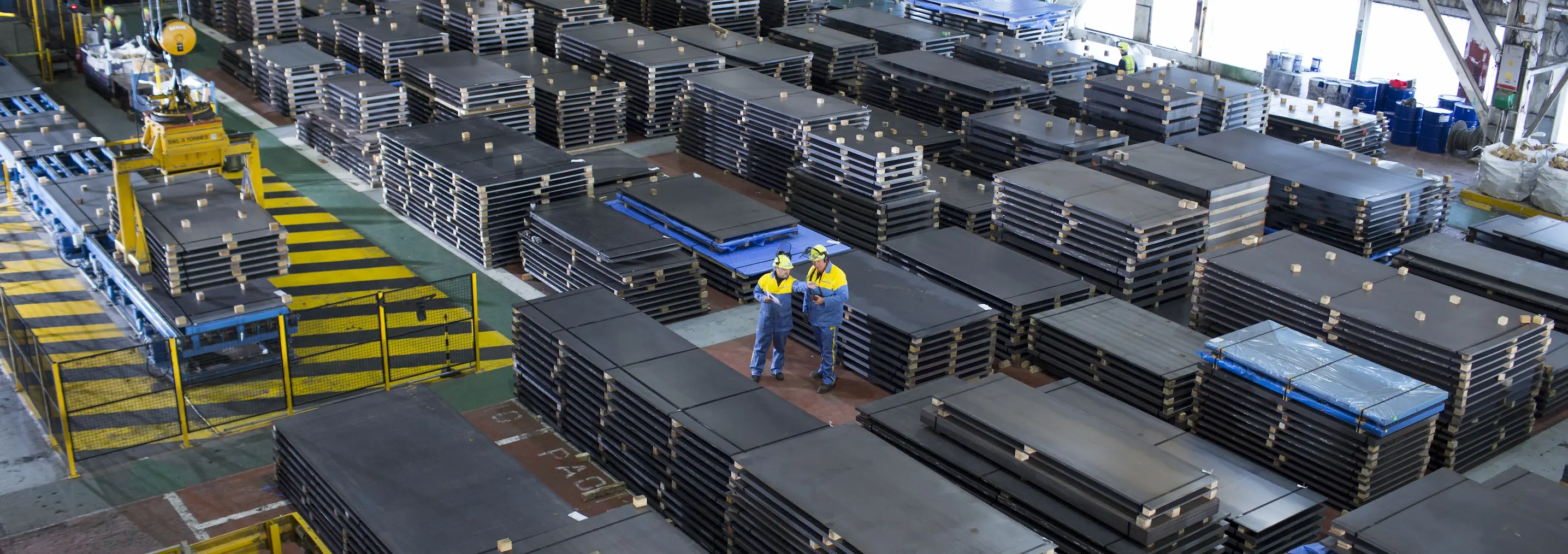
Stainless steel, duplex, carbon steel and alloy steel sheets and plates, with nickel alloys, titanium, copper, brass and aluminium — and the grades, chemistry, finishes, weight chart and tolerances you need to specify them.
We supply hot rolled plates, cold rolled sheets, chequered plates, perforated sheets and clad plates in stainless steel, duplex, super duplex, carbon steel and alloy steel — and in high nickel alloys, titanium, copper, brass and aluminium when the service calls for them.
Material is supplied in standard sizes or cut to the dimensions you need. Every plate and every bundle of sheets is identified by its heat number and supplied with a mill test certificate to EN 10204 Type 3.1 or 3.2. When your project needs independent verification, inspection by your nominated agency is carried out before dispatch.
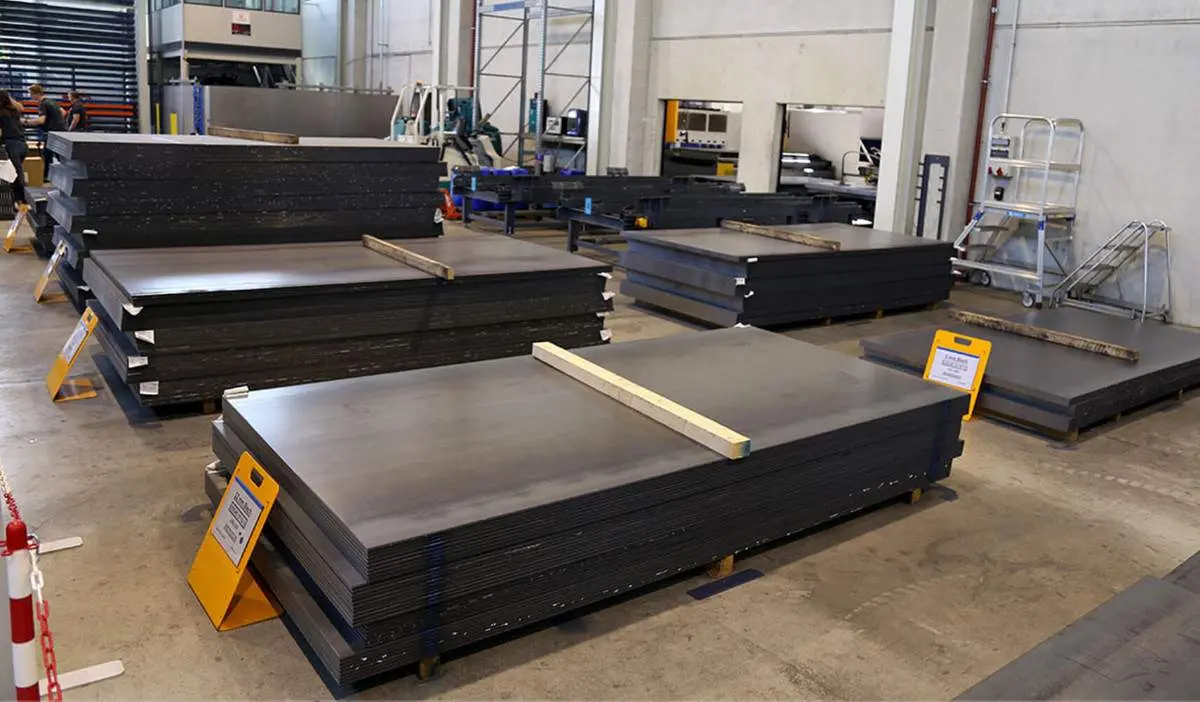
The three names describe the same flat-rolled metal in different dimensions. These are the definitions ASTM A480 uses for stainless steel, and the trade follows them for most other metals.
Under 5 mm (3/16") thick, and 600 mm or wider. Usually cold rolled, with a smooth surface and close thickness tolerance. Ordered by thickness in mm or by gauge.
Example: 2 mm × 1250 × 2500 mm, 304, 2B finish5 mm (3/16") and thicker, and over 250 mm wide. Usually hot rolled. Used for pressure vessels, tanks, structures and machined parts. Ordered by thickness in mm.
Example: 12 mm × 1500 × 6000 mm, A516 Gr. 70, normalisedUnder 5 mm thick, and under 600 mm wide. Cold rolled and slit to width, supplied in coil or in cut lengths. See Coils & Strips.
Example: 0.8 mm × 300 mm wide, 316L, in coilHow the material is rolled and finished decides its thickness range, its surface and what it is used for. Clad plates are covered further down the page.
Rolled from slab at high temperature. The heavier thicknesses, for load-bearing and pressure-containing fabrication.
Hot rolled material rolled again at room temperature, for thin gauges, a smooth surface and close tolerance.
Plate rolled with a raised pattern on one face, which gives grip underfoot and stiffens the plate.
Sheet punched with round, square or slotted holes to the pattern, hole size and pitch you specify.
Choose a material family to see the grades we supply, their international designations, and the specifications that cover plate, sheet and strip.
One specification, ASTM A240, covers stainless plate, sheet and strip. The austenitic 300 series makes up most of the demand; heat-resisting, ferritic and martensitic grades complete the range.
| Grade | UNS | EN / W.Nr. | Where it is used |
|---|---|---|---|
| 304 / 304L | S30400 / S30403 | 1.4301 / 1.4307 | Tanks, food and dairy equipment, kitchens and architectural panels. 304L for welded fabrication. |
| 304H | S30409 | 1.4948 | Higher carbon for strength above 525 °C. |
| 316 / 316L | S31600 / S31603 | 1.4401 / 1.4404 | Chemical and pharmaceutical vessels, coastal and marine fabrication. |
| 316Ti | S31635 | 1.4571 | Titanium-stabilised 316 for welded equipment at elevated temperature. |
| 317L | S31703 | 1.4438 | More molybdenum than 316L — pulp, paper and flue-gas scrubbers. |
| 321 / 321H | S32100 / S32109 | 1.4541 / 1.4878 | Stabilised against weld decay — exhaust systems and expansion bellows. |
| 347 / 347H | S34700 / S34709 | 1.4550 / 1.4961 | Niobium-stabilised — refinery and high-temperature equipment. |
| 309S / 310S | S30908 / S31008 | 1.4833 / 1.4845 | Heat-resisting grades — furnace linings, burners and heat-treatment trays. |
| 904L | N08904 | 1.4539 | Super-austenitic — sulphuric and phosphoric acid equipment. |
| 409 / 430 | S40900 / S43000 | 1.4512 / 1.4016 | Ferritic and magnetic — exhausts, appliances and interior trim at lower cost. |
| 410 / 420 | S41000 / S42000 | 1.4006 / 1.4021 | Martensitic and hardenable — wear parts, blades and cutlery. |
A two-phase structure gives roughly twice the yield strength of 316L, so vessels and tanks can be built from thinner plate. Resistance to chloride pitting and stress-corrosion cracking rises with each step up the family.
| Grade | UNS | EN / W.Nr. | Where it is used |
|---|---|---|---|
| Lean Duplex 2101 | S32101 | 1.4162 | Storage tanks and structures, in place of 304 where higher strength helps. |
| Lean Duplex 2304 | S32304 | 1.4362 | Molybdenum-free duplex with corrosion resistance close to 316L. |
| Duplex 2205 | S31803 / S32205 | 1.4462 | The standard duplex — pressure vessels, chemical tankers and desalination. |
| Super Duplex 2507 | S32750 | 1.4410 | Seawater systems, offshore topsides and high-chloride process plant. |
| Super Duplex S32760 | S32760 | 1.4501 | With tungsten and copper — seawater and sour oil-and-gas service. |
Carbon steel plate is specified by standard and grade together. Structural grades are chosen for strength; pressure vessel and boiler grades also control toughness and behaviour at temperature.
| Specification & grade | Type | Where it is used |
|---|---|---|
| ASTM A36 | Structural | General fabrication — base plates, frames, supports and brackets. |
| ASTM A572 Gr. 50 | High-strength structural | Bridges, cranes and structures where weight must be saved. |
| IS 2062 E250 / E350 | Structural, Indian standard | The general-purpose structural plate of the Indian market. |
| EN 10025 S235JR / S275JR / S355J2 | Structural, European standard | Structural fabrication to European project specifications. |
| ASTM A283 Gr. C / A285 Gr. C | Low and intermediate strength | Storage tanks and low-pressure vessels. |
| ASTM A516 Gr. 60 / 65 / 70 | Pressure vessel | The most-specified vessel plate, for moderate and lower temperature service. |
| ASTM A515 Gr. 60 / 70 | Pressure vessel | Boilers and vessels for intermediate and higher temperature service. |
| ASTM A537 Cl. 1 / Cl. 2 | Pressure vessel, heat-treated | Higher strength with good low-temperature toughness. |
| IS 2002 Gr. 1 / 2 / 3 | Boiler quality, Indian standard | Boilers and pressure vessels built to Indian codes. |
| EN 10028-2 P265GH / P355GH | Pressure vessel, European standard | Boilers and vessels for elevated-temperature service. |
Chromium-molybdenum plate keeps its strength at temperatures where carbon steel creeps, and resists attack by hot hydrogen. Most grades are made in two strength classes.
| Specification & grade | Nominal composition | Classes | Where it is used |
|---|---|---|---|
| A387 Gr. 5 | 5Cr – ½Mo | Cl. 1 · Cl. 2 | Refinery equipment handling hot sulphur-bearing streams. |
| A387 Gr. 9 | 9Cr – 1Mo | Cl. 1 · Cl. 2 | Higher-temperature refinery and heater service. |
| A387 Gr. 11 | 1¼Cr – ½Mo – Si | Cl. 1 · Cl. 2 | Reactors, heat-exchanger shells and steam drums. |
| A387 Gr. 12 | 1Cr – ½Mo | Cl. 1 · Cl. 2 | Boilers and pressure vessels at elevated temperature. |
| A387 Gr. 22 | 2¼Cr – 1Mo | Cl. 1 · Cl. 2 | Hydroprocessing reactors and high-pressure hydrogen service. |
| A387 Gr. 91 | 9Cr – 1Mo – V | Cl. 2 | Headers and vessels in modern power plants. |
| A204 Gr. B | C – ½Mo | – | Boilers and vessels at moderately elevated temperature. |
| EN 10028-2 16Mo3 | 0.3Mo | – | The European elevated-temperature boiler plate. |
Inconel, Incoloy, Monel and Hastelloy are specified where stainless steel reaches its limit. Each alloy has its own ASTM specification for plate, sheet and strip.
| Alloy | UNS | W.Nr. | Plate & sheet | Where it is used |
|---|---|---|---|---|
| Nickel 200 / 201 | N02200 / N02201 | 2.4066 / 2.4068 | B162 | Caustic soda and alkali equipment. |
| Monel 400 | N04400 | 2.4360 | B127 | Seawater and hydrofluoric acid service. |
| Inconel 600 | N06600 | 2.4816 | B168 | Furnace and heat-treatment components. |
| Inconel 601 | N06601 | 2.4851 | B168 | Oxidation resistance at very high temperature. |
| Inconel 625 | N06625 | 2.4856 | B443 | Seawater, flue-gas and chemical process equipment. |
| Incoloy 800 / 800H / 800HT | N08800 / N08810 / N08811 | 1.4876 / 1.4958 / 1.4959 | B409 | Petrochemical furnaces and reformers. |
| Incoloy 825 | N08825 | 2.4858 | B424 | Sulphuric and phosphoric acid plant. |
| Hastelloy C276 | N10276 | 2.4819 | B575 | Wet chlorine, mixed acids and flue-gas scrubbers. |
| Hastelloy C22 | N06022 | 2.4602 | B575 | Oxidising and mixed-acid environments. |
| Alloy 20 | N08020 | 2.4660 | B463 | Sulphuric acid handling. |
About half the weight of steel, and effectively immune to seawater. Commercially pure grades are used for process equipment; Grade 5 is the high-strength alloy.
| Grade | UNS | Type | Where it is used |
|---|---|---|---|
| Grade 1 | R50250 | Commercially pure | The softest grade — deep drawing and cladding. |
| Grade 2 | R50400 | Commercially pure | The workhorse — vessels, tube sheets and chlor-alkali plant. |
| Grade 5 | R56400 | Ti – 6Al – 4V | High-strength alloy for aerospace and engineered parts. |
| Grade 7 | R52400 | Ti – 0.15Pd | Palladium-bearing, for reducing acids. |
| Grade 12 | R53400 | Ti – 0.3Mo – 0.8Ni | Better crevice-corrosion resistance at higher temperature. |
Copper for electrical and thermal conductivity; brass and copper-nickel for tube sheets, marine hardware and general engineering.
| Alloy | UNS | Specification | Where it is used |
|---|---|---|---|
| ETP Copper | C11000 | B152 | Busbars, earthing and electrical components. |
| Oxygen-Free Copper | C10200 | B152 | Electrical and vacuum service. |
| DHP Copper | C12200 | B152 | Welded and brazed fabrication, heat-transfer equipment. |
| Cartridge Brass 70/30 | C26000 | B36 | Deep-drawn and formed components. |
| Muntz Metal 60/40 | C28000 | B36 | Architectural panels and condenser plates. |
| Naval Brass | C46400 | B171 | Heat-exchanger tube sheets and marine hardware. |
| Copper-Nickel 90/10 · 70/30 | C70600 / C71500 | B171 · B122 | Seawater systems, condensers and tube sheets. |
A third the weight of steel, with natural corrosion resistance. The 5000 series is chosen for marine work; 6061 and 7075 for structural and machined parts.
| Alloy | UNS | Common temper | Where it is used |
|---|---|---|---|
| 1100 | A91100 | O / H14 | Commercially pure — ducting, insulation cladding and chemical trays. |
| 3003 | A93003 | H14 | General sheet-metal work, tanks and panels. |
| 5052 | A95052 | H32 | Marine and transport panels, fuel tanks. |
| 5083 | A95083 | O / H111 / H116 | Shipbuilding, cryogenic tanks and pressure vessels. |
| 6061 | A96061 | T6 / T651 | Structural and machined components. |
| 7075 | A97075 | T6 / T651 | High-strength aerospace and tooling plate. |
Swipe the table sideways to see every column
These are the grades asked for most, not the limit of what we supply. For designations of every family in other product forms, see Materials & Grades.
Composition limits from the plate specifications, in percent by weight. A single figure is a maximum; a range shows minimum and maximum.
| Grade | C | Mn | P | S | Si | Cr | Ni | Mo | N | Others |
|---|---|---|---|---|---|---|---|---|---|---|
| Austenitic | ||||||||||
| 304 | 0.07 | 2.00 | 0.045 | 0.030 | 0.75 | 17.5 – 19.5 | 8.0 – 10.5 | – | 0.10 | – |
| 304L | 0.030 | 2.00 | 0.045 | 0.030 | 0.75 | 17.5 – 19.5 | 8.0 – 12.0 | – | 0.10 | – |
| 304H | 0.04 – 0.10 | 2.00 | 0.045 | 0.030 | 0.75 | 18.0 – 20.0 | 8.0 – 10.5 | – | – | – |
| 316 | 0.08 | 2.00 | 0.045 | 0.030 | 0.75 | 16.0 – 18.0 | 10.0 – 14.0 | 2.00 – 3.00 | 0.10 | – |
| 316L | 0.030 | 2.00 | 0.045 | 0.030 | 0.75 | 16.0 – 18.0 | 10.0 – 14.0 | 2.00 – 3.00 | 0.10 | – |
| 316Ti | 0.08 | 2.00 | 0.045 | 0.030 | 0.75 | 16.0 – 18.0 | 10.0 – 14.0 | 2.00 – 3.00 | 0.10 | Ti 5×(C+N) – 0.70 |
| 317L | 0.030 | 2.00 | 0.045 | 0.030 | 0.75 | 18.0 – 20.0 | 11.0 – 15.0 | 3.0 – 4.0 | 0.10 | – |
| 321 | 0.08 | 2.00 | 0.045 | 0.030 | 0.75 | 17.0 – 19.0 | 9.0 – 12.0 | – | 0.10 | Ti 5×(C+N) – 0.70 |
| 347 | 0.08 | 2.00 | 0.045 | 0.030 | 0.75 | 17.0 – 19.0 | 9.0 – 13.0 | – | – | Nb 10×C – 1.00 |
| 310S | 0.08 | 2.00 | 0.045 | 0.030 | 1.50 | 24.0 – 26.0 | 19.0 – 22.0 | – | – | – |
| 904L | 0.020 | 2.00 | 0.045 | 0.035 | 1.00 | 19.0 – 23.0 | 23.0 – 28.0 | 4.0 – 5.0 | 0.10 | Cu 1.0 – 2.0 |
| Ferritic & martensitic | ||||||||||
| 430 | 0.12 | 1.00 | 0.040 | 0.030 | 1.00 | 16.0 – 18.0 | 0.75 | – | – | – |
| 410 | 0.08 – 0.15 | 1.00 | 0.040 | 0.030 | 1.00 | 11.5 – 13.5 | 0.75 | – | – | – |
| Duplex & super duplex | ||||||||||
| S31803 (2205) | 0.030 | 2.00 | 0.030 | 0.020 | 1.00 | 21.0 – 23.0 | 4.5 – 6.5 | 2.5 – 3.5 | 0.08 – 0.20 | – |
| S32205 (2205) | 0.030 | 2.00 | 0.030 | 0.020 | 1.00 | 22.0 – 23.0 | 4.5 – 6.5 | 3.0 – 3.5 | 0.14 – 0.20 | – |
| S32750 (2507) | 0.030 | 1.20 | 0.035 | 0.020 | 0.80 | 24.0 – 26.0 | 6.0 – 8.0 | 3.0 – 5.0 | 0.24 – 0.32 | Cu 0.50 |
| S32760 | 0.030 | 1.00 | 0.030 | 0.010 | 1.00 | 24.0 – 26.0 | 6.0 – 8.0 | 3.0 – 4.0 | 0.20 – 0.30 | Cu 0.50 – 1.00 · W 0.50 – 1.00 |
| Grade | C | Mn | P | S | Si | Cr | Mo | Others |
|---|---|---|---|---|---|---|---|---|
| Carbon steel | ||||||||
| A36 * | 0.25 | – | 0.030 | 0.030 | 0.40 | – | – | – |
| IS 2062 E250 A | 0.23 | 1.50 | 0.045 | 0.045 | 0.40 | – | – | – |
| A285 Gr. C | 0.28 | 0.90 | 0.025 | 0.025 | – | – | – | – |
| A516 Gr. 60 * | 0.21 | 0.60 – 0.90 | 0.025 | 0.025 | 0.15 – 0.40 | – | – | – |
| A516 Gr. 70 * | 0.27 | 0.85 – 1.20 | 0.025 | 0.025 | 0.15 – 0.40 | – | – | – |
| A537 Cl. 1 | 0.24 | 0.70 – 1.35 | 0.025 | 0.025 | 0.15 – 0.50 | 0.25 | 0.08 | Cu 0.35 · Ni 0.25 |
| Alloy steel · ASTM A387 | ||||||||
| Gr. 11 | 0.05 – 0.17 | 0.40 – 0.65 | 0.025 | 0.025 | 0.50 – 0.80 | 1.00 – 1.50 | 0.45 – 0.65 | – |
| Gr. 12 | 0.05 – 0.17 | 0.40 – 0.65 | 0.025 | 0.025 | 0.15 – 0.40 | 0.80 – 1.15 | 0.45 – 0.60 | – |
| Gr. 22 | 0.05 – 0.15 | 0.30 – 0.60 | 0.025 | 0.025 | 0.50 | 2.00 – 2.50 | 0.90 – 1.10 | – |
| Gr. 91 | 0.08 – 0.12 | 0.30 – 0.60 | 0.020 | 0.010 | 0.20 – 0.50 | 8.00 – 9.50 | 0.85 – 1.05 | V 0.18 – 0.25 · Nb 0.06 – 0.10 · N 0.030 – 0.070 |
Swipe the tables sideways to see every element
* Carbon and manganese limits of A36 and A516 change with plate thickness. The figures shown are for the thinnest range: up to 20 mm for A36 and up to 12.5 mm for A516.
Values are shown for reference and follow the specifications named in each table. Limits are revised from time to time, so the edition of the specification on your order, and the mill test certificate supplied with the material, always govern.
Yield strength sets how thick a plate must be to carry its load. For furnace and high-temperature work, resistance to scaling matters as much. The full minimum values are in the table below.
MPa · minimum required by the plate specification
A duplex plate carries more than twice the load of a 316L plate of the same thickness, so the vessel wall can be thinner and lighter.
°C · maximum temperature in continuous service, typical
These figures describe resistance to oxidation only. Strength falls well before these temperatures are reached, so the design code sets the allowable stress.
| Grade | Specification | Tensile strength MPa | Yield strength, min MPa | Elongation, min % in 50 mm | Hardness, max HBW |
|---|---|---|---|---|---|
| Stainless steel | |||||
| 304 · 304H | ASTM A240 | 515 min | 205 | 40 | 201 |
| 304L | ASTM A240 | 485 min | 170 | 40 | 201 |
| 316 · 316Ti · 317L · 321 · 310S | ASTM A240 | 515 min | 205 | 40 | 217 |
| 316L | ASTM A240 | 485 min | 170 | 40 | 217 |
| 347 | ASTM A240 | 515 min | 205 | 40 | 201 |
| 904L | ASTM A240 | 490 min | 220 | 35 | – |
| 430 | ASTM A240 | 450 min | 205 | 22 | 183 |
| 410 | ASTM A240 | 450 min | 205 | 20 | 217 |
| Duplex & super duplex | |||||
| S31803 (2205) | ASTM A240 | 620 min | 450 | 25 | 293 |
| S32205 (2205) | ASTM A240 | 655 min | 450 | 25 | 293 |
| S32750 (2507) | ASTM A240 | 795 min | 550 | 15 | 310 |
| S32760 | ASTM A240 | 750 min | 550 | 25 | 270 |
| Carbon steel | |||||
| A36 | ASTM A36 | 400 – 550 | 250 | 23 | – |
| IS 2062 E250 | IS 2062 | 410 min | 250 | 23 | – |
| IS 2062 E350 | IS 2062 | 490 min | 350 | 22 | – |
| A285 Gr. C | ASTM A285 | 380 – 515 | 205 | 27 | – |
| A516 Gr. 60 | ASTM A516 | 415 – 550 | 220 | 25 | – |
| A516 Gr. 70 | ASTM A516 | 485 – 620 | 260 | 21 | – |
| A537 Cl. 1 | ASTM A537 | 485 – 620 | 345 | 22 | – |
| Alloy steel | |||||
| Gr. 11 Cl. 1 | ASTM A387 | 415 – 585 | 240 | 22 | – |
| Gr. 11 Cl. 2 · Gr. 22 Cl. 2 | ASTM A387 | 515 – 690 | 310 | 22 · 18 | – |
| Gr. 12 Cl. 2 | ASTM A387 | 450 – 585 | 275 | 22 | – |
| Gr. 22 Cl. 1 | ASTM A387 | 415 – 585 | 205 | 18 | – |
| Gr. 91 Cl. 2 | ASTM A387 | 585 – 760 | 415 | 18 | – |
Swipe the table sideways to see every column
Yield strength of carbon steel plate is for the thinnest range and falls as thickness increases: for IS 2062, under 20 mm; for A537 Class 1, up to 65 mm. Actual test results are reported on the mill test certificate.
The finish affects appearance, cleanability and cost. Mill finishes come from rolling and annealing; polished finishes are applied afterwards. Designations follow ASTM A480.
A dull, slightly rough surface. The standard finish of hot rolled plate.
Used forVessels, tanks and industrial fabrication where appearance is secondary
Cold rolled, annealed and pickled. Smooth and matt, and it holds lubricant well.
Used forDeep-drawn parts, industrial and chemical equipment
As 2D, with a light final pass on polished rolls. The most widely used sheet finish.
Used forTanks, process and pharmaceutical equipment; the base for polishing
Annealed in a protective atmosphere, so the surface stays bright and reflective without polishing.
Used forAppliances, reflectors, trim and kitchenware
A coarse, one-directional polish with a visible grain, made with 100 to 120 grit abrasive.
Used forBrewery and food equipment, or as a step before finer polishing
The familiar satin finish with a fine, short grain, made with 150 to 180 grit abrasive.
Used forKitchens, lifts, dairy and food-processing equipment
Long, continuous polishing lines that run the full length of the sheet.
Used forLift panels, architectural cladding and interiors
Polished with successively finer abrasives and then buffed until the grain lines disappear.
Used forDecorative panels, signage and reflectors
The swatches are drawings that suggest each finish. Polished sheets are supplied with a protective film on the finished face when you ask for it. Carbon and alloy steel plate is supplied as rolled, normalised, or quenched and tempered, as the specification requires.
Theoretical weight in kilograms for the standard sizes. Choose the material, and click any value to load that thickness and size into the weight calculator.
| Thicknessmm | Thicknessinch | Per m²kg | 1000 × 2000mm | 1219 × 24384 × 8 ft | 1250 × 2500mm | 1500 × 3000mm | 1500 × 6000mm | 2000 × 6000mm |
|---|---|---|---|---|---|---|---|---|
| 0.5 | 0.020 | 3.97 | 7.93 | 11.78 | 12.39 | 17.84 | 35.69 | 47.58 |
| 0.6 | 0.024 | 4.76 | 9.52 | 14.14 | 14.87 | 21.41 | 42.82 | 57.10 |
| 0.8 | 0.031 | 6.34 | 12.69 | 18.85 | 19.83 | 28.55 | 57.10 | 76.13 |
| 1.0 | 0.039 | 7.93 | 15.86 | 23.57 | 24.78 | 35.69 | 71.37 | 95.16 |
| 1.2 | 0.047 | 9.52 | 19.03 | 28.28 | 29.74 | 42.82 | 85.64 | 114.2 |
| 1.5 | 0.059 | 11.90 | 23.79 | 35.35 | 37.17 | 53.53 | 107.1 | 142.7 |
| 2.0 | 0.079 | 15.86 | 31.72 | 47.13 | 49.56 | 71.37 | 142.7 | 190.3 |
| 2.5 | 0.098 | 19.83 | 39.65 | 58.92 | 61.95 | 89.21 | 178.4 | 237.9 |
| 3.0 | 0.118 | 23.79 | 47.58 | 70.70 | 74.34 | 107.1 | 214.1 | 285.5 |
| 4.0 | 0.157 | 31.72 | 63.44 | 94.27 | 99.13 | 142.7 | 285.5 | 380.6 |
| 5.0 | 0.197 | 39.65 | 79.30 | 117.8 | 123.9 | 178.4 | 356.9 | 475.8 |
| 6.0 | 0.236 | 47.58 | 95.16 | 141.4 | 148.7 | 214.1 | 428.2 | 571.0 |
| 8.0 | 0.315 | 63.44 | 126.9 | 188.5 | 198.3 | 285.5 | 571.0 | 761.3 |
| 10 | 0.394 | 79.30 | 158.6 | 235.7 | 247.8 | 356.9 | 713.7 | 951.6 |
| 12 | 0.472 | 95.16 | 190.3 | 282.8 | 297.4 | 428.2 | 856.4 | 1,142 |
| 16 | 0.630 | 126.9 | 253.8 | 377.1 | 396.5 | 571.0 | 1,142 | 1,523 |
| 20 | 0.787 | 158.6 | 317.2 | 471.3 | 495.6 | 713.7 | 1,427 | 1,903 |
| 25 | 0.984 | 198.3 | 396.5 | 589.2 | 619.5 | 892.1 | 1,784 | 2,379 |
| 32 | 1.260 | 253.8 | 507.5 | 754.2 | 793.0 | 1,142 | 2,284 | 3,045 |
| 40 | 1.575 | 317.2 | 634.4 | 942.7 | 991.3 | 1,427 | 2,855 | 3,806 |
| 50 | 1.969 | 396.5 | 793.0 | 1,178 | 1,239 | 1,784 | 3,569 | 4,758 |
Swipe the chart sideways to see every size
Reading the chart: the chart is a weight reference, so it shows every combination of thickness and size. Not every thickness is rolled in every size; tell us what you need and we will confirm what is available. For other materials, use the calculator below.
Enter any thickness and size, or click a value in the chart above.
kg = thickness × width × length × density ÷ 1,000,000
Enquire for this sizeWeights are theoretical, based on nominal dimensions. Actual weight varies within the tolerances of the specification.
Sheets and plates are rolled in a small number of standard formats. Thin sheet is still often ordered by gauge number, so check which gauge system your drawing uses.
| Gauge | SWG mm | US steel mm | US stainless mm |
|---|---|---|---|
| 8 | 4.064 | 4.176 | 4.366 |
| 10 | 3.251 | 3.416 | 3.571 |
| 11 | 2.946 | 3.038 | 3.175 |
| 12 | 2.642 | 2.657 | 2.779 |
| 14 | 2.032 | 1.897 | 1.984 |
| 16 | 1.626 | 1.519 | 1.588 |
| 18 | 1.219 | 1.214 | 1.270 |
| 20 | 0.914 | 0.912 | 0.953 |
| 22 | 0.711 | 0.759 | 0.794 |
| 24 | 0.559 | 0.607 | 0.635 |
| 26 | 0.457 | 0.455 | 0.478 |
| 28 | 0.376 | 0.378 | 0.397 |
| 30 | 0.315 | 0.305 | 0.318 |
SWG is the British Standard Wire Gauge used in India. "US steel" is the Manufacturers' Standard Gauge for carbon steel sheet; "US stainless" is the US Standard Gauge used for stainless steel. The same gauge number means a different thickness in each system.
To avoid a mistake, state the thickness in millimetres on your enquiry, with the gauge number only as a reference.
A clad plate bonds a thin layer of corrosion-resistant alloy onto a carbon or alloy steel backing plate. The process side gets the chemistry of the alloy; the steel carries the load. For thick vessel walls, this costs far less than solid alloy plate.
Standard thickness tolerances from the general-requirement specifications. Tighter tolerances can be agreed when you order.
| Specified thickness | Tolerance, over and under |
|---|---|
| Sheet width up to 1000 mm | |
| 0.30 mm | ±0.03 mm |
| 0.40 mm | ±0.04 mm |
| 0.50 mm | ±0.045 mm |
| 0.80 mm | ±0.05 mm |
| 1.00 mm | ±0.055 mm |
| 1.50 mm | ±0.08 mm |
| 2.00 mm | ±0.10 mm |
| 3.00 mm | ±0.13 mm |
| 4.00 mm | ±0.17 mm |
| 5.00 mm | ±0.17 mm |
| Nominal thickness | Tolerance |
|---|---|
| Under and over the nominal thickness | |
| 3 to under 5 mm | −0.3 / +0.7 mm |
| 5 to under 8 mm | −0.4 / +0.8 mm |
| 8 to under 15 mm | −0.5 / +0.9 mm |
| 15 to under 25 mm | −0.6 / +1.0 mm |
| 25 to under 40 mm | −0.7 / +1.3 mm |
| 40 to under 80 mm | −0.9 / +1.7 mm |
| 80 to under 150 mm | −1.1 / +2.1 mm |
| ASTM plate · A480, A6 and A20 | |
| Under the ordered thickness | 0.25 mm, max |
| Over the ordered thickness | By thickness and width |
Full sheets and plates in the standard widths and lengths, with mill or trimmed edges.
Rectangular pieces cut to the width and length on your cutting list, ready for fabrication.
Circles for dished ends and tube sheets, rings for flanges, and profiles cut to your drawing.
A starting point for matching the material to the application. Tell us what the plate will be made into, and we will quote the grades that fit.
| Application | Typical choice | Why |
|---|---|---|
| Storage tanks, food & dairy equipment | SS 304 / 304L | Good all-round corrosion resistance at the lowest stainless cost. |
| Chemical & pharmaceutical vessels | SS 316 / 316L | Molybdenum resists chlorides and pitting where 304 would fail. |
| Pressure vessels & boilers | A516 Gr. 60 / 70 · IS 2002 | Notch-tough vessel plate with controlled chemistry. |
| Reactors & vessels at high temperature | A387 Gr. 11 · Gr. 22 · Gr. 91 | Chromium-molybdenum keeps strength and resists hot hydrogen. |
| Structures & general fabrication | A36 · IS 2062 E250 / E350 | Weldable structural plate, economical and widely available. |
| Furnace parts & heat treatment | SS 310S · 321 · Inconel 600 · 800H | High chromium and nickel resist scaling at temperature. |
| Seawater, desalination & offshore | Duplex 2205 · 2507 · Cu-Ni 90/10 | High strength with resistance to chloride attack. |
| Sulphuric & phosphoric acid | 904L · Alloy 20 · Incoloy 825 | High nickel, molybdenum and copper for reducing acids. |
| Wet chlorine, mixed acids, flue gas | Hastelloy C276 · C22 | The broadest chemical resistance of any wrought alloy. |
| Heat-exchanger tube sheets | Naval brass · Cu-Ni · Titanium Gr. 2 | Chosen to match the tubes and the cooling water. |
| Thick-walled vessels in corrosive service | Clad plate | Alloy on the process side, steel for strength, at lower cost. |
| Marine, transport & lightweight structures | Aluminium 5083 · 5052 · 6061 | A third the weight of steel, with good corrosion resistance. |
Swipe the table sideways to see every column
This guide is for orientation only. Final material selection depends on the full service conditions and the governing design code, and remains the responsibility of the design engineer.
Every lot is traceable to its heat number and leaves with its mill test certificate. These tests are arranged when your order calls for them.
Thickness. ASTM A480 calls flat stainless steel under 5 mm (3/16 inch) thick a sheet when it is 600 mm or wider, and a strip when it is narrower. Material 5 mm and thicker, and over 250 mm wide, is a plate. Sheets are usually cold rolled; plates are usually hot rolled.
Hot rolled material is rolled above its recrystallisation temperature. It is made in heavier thicknesses, with a dull scaled or pickled surface and wider tolerances. Cold rolled material is rolled further at room temperature, which gives thinner gauges, a smooth surface and closer thickness tolerances.
2B is the standard mill finish for tanks and process equipment, and the usual starting point for polishing. BA is bright and reflective without polishing. No. 4 is the brushed finish used for kitchens, lifts and food equipment. No. 8 is a mirror polish for decorative work. See the surface finishes.
Multiply the thickness in millimetres by the width in metres, the length in metres and the density in grams per cubic centimetre. The answer is in kilograms. A 2 mm sheet of stainless steel 304 measuring 1.25 m by 2.5 m weighs 2 × 1.25 × 2.5 × 7.93 = 49.56 kg. The weight calculator does this for you.
Yes. Besides standard sizes, sheets and plates are supplied cut to the dimensions or drawing you send: rectangular blanks, circles, rings and profiles. The cutting method is chosen to suit the material and thickness.
Every lot is supplied with a mill test certificate to EN 10204 Type 3.1 or 3.2, traceable to the heat number marked on the material, along with any additional test reports ordered. When third-party inspection is called for, the agency's inspection release note is included. More on our quality & inspection page.
Pipes, fittings, flanges, bars and structurals in matching grades, so the vessel and the piping around it come from one supplier with one set of documents.
Send the grade, thickness, size and quantity. We will confirm availability and quote, with the mill test certificate and inspection you need.