
Round Bar
Ordered by diameterShafts, pins, bolts, spindles and turned parts. The most common bar.
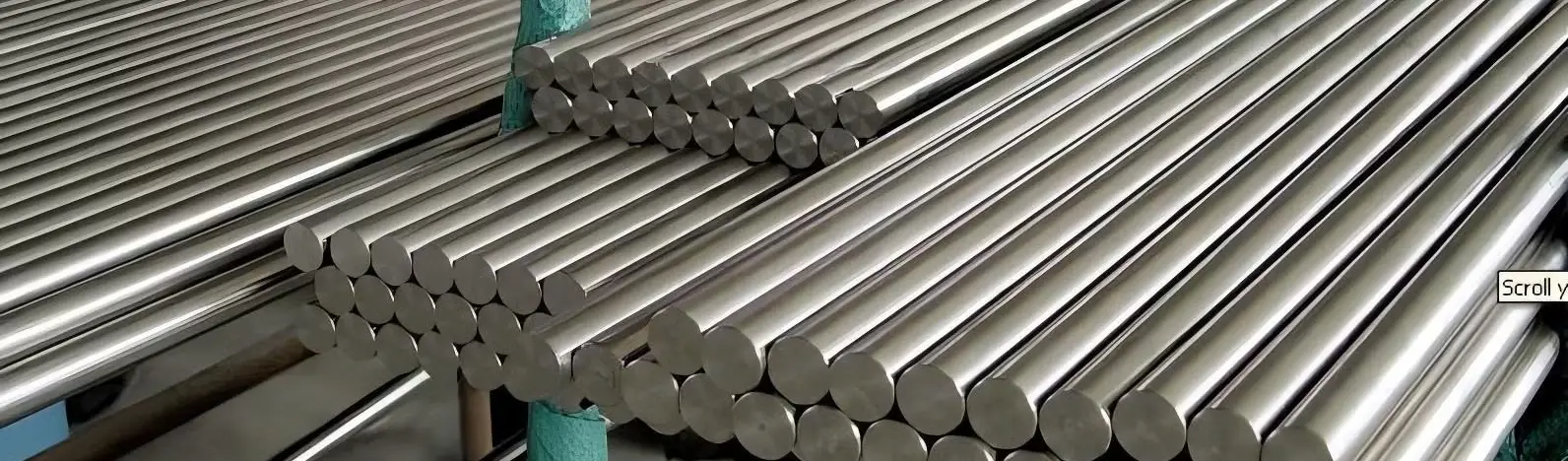
Round, hex, square, flat and hollow bars in stainless steel, duplex, carbon steel, alloy steel, nickel alloys, titanium, copper, brass and aluminium — with the grades, strengths, weights and tolerances you need to specify them.
We supply round, hex, square, flat and hollow bars in stainless steel, duplex, super duplex, carbon steel and alloy steel — and in nickel alloys, titanium, copper, brass and aluminium — for shafts, fasteners, valve and pump parts and machined components.
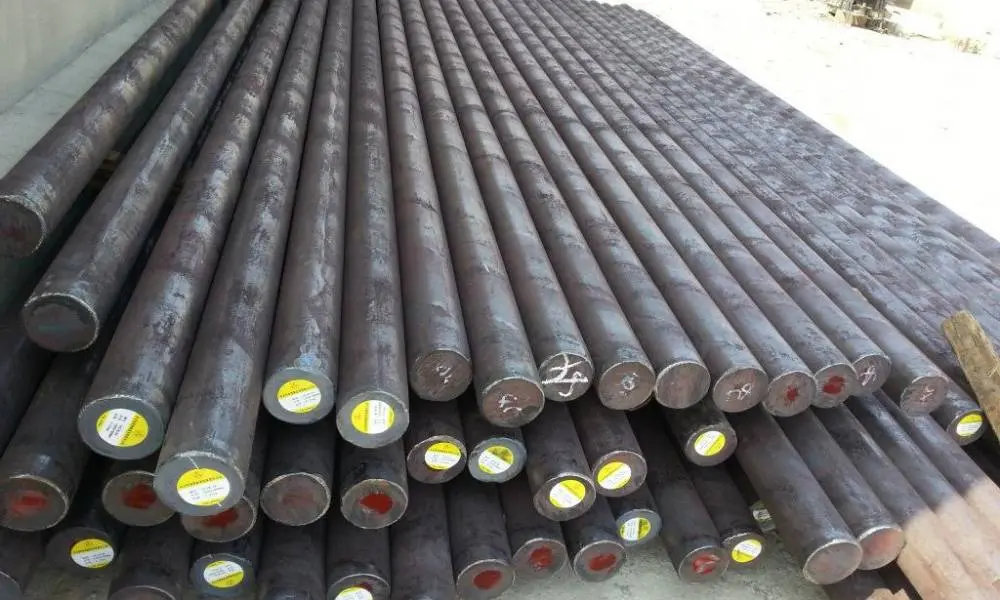
Bars are supplied black, peeled, bright drawn or ground, in random lengths or cut to the lengths you need. Every bundle carries its heat number and is supplied with a mill test certificate to EN 10204 Type 3.1 or 3.2. When your project needs independent verification, inspection by your nominated agency is carried out before dispatch.
Each shape is ordered by a different dimension. Getting it right matters most for hex bar, which is sized across its flats, not across its corners.
Shafts, pins, bolts, spindles and turned parts. The most common bar.
Nuts, fittings and parts that are gripped by a spanner.
Keys, blocks and machined parts with flat faces.
Brackets, supports, gaskets, wear strips and fabrication.
Thick-walled bar for bushes, sleeves and rings, saving material and machining time.
The finish sets the surface and how close the diameter is held, and so how much machining the bar needs. Tolerance classes are explained further down the page.
Rolled at high temperature, with the dark mill scale or a pickled surface. The widest size tolerance.
Best forForging stock, and parts that will be fully machined
Forged from ingot or bloom and usually rough turned. For the largest diameters and the soundest core.
Best forLarge shafts, flanges, rings and heavy machined parts
The skin is turned off on a lathe, removing scale and surface defects and leaving fine turning marks.
ToleranceTypically h11 or k12
Cold drawn through a die for a smooth, bright surface and a close diameter. Drawing also raises strength.
ToleranceTypically h9 to h11
Ground between wheels after drawing or peeling, for the closest diameter tolerance and roundness.
ToleranceTypically h8 or h9; h7 on request
Ground bar polished to a bright, reflective finish with a low surface roughness.
Best forPump shafts, piston rods and visible parts
Choose a material family to see the bar grades we supply, their international designations, and the specifications that cover them.
Austenitic grades for corrosion resistance, free-machining grades for high-volume turning, and martensitic and precipitation-hardening grades where strength and hardness are needed.
| Grade | UNS | EN / W.Nr. | Where it is used |
|---|---|---|---|
| 303 | S30300 | 1.4305 | Free-machining austenitic — turned parts in high volume. |
| 304 / 304L | S30400 / S30403 | 1.4301 / 1.4307 | General machined parts, shafts and fasteners. |
| 316 / 316L | S31600 / S31603 | 1.4401 / 1.4404 | Marine, chemical and pharmaceutical components. |
| 316Ti | S31635 | 1.4571 | Titanium-stabilised 316 for welded parts at temperature. |
| 321 / 347 | S32100 / S34700 | 1.4541 / 1.4550 | Stabilised grades for high-temperature service. |
| 310S | S31008 | 1.4845 | Furnace parts and heat-treatment fixtures. |
| 904L | N08904 | 1.4539 | Super-austenitic — acid service and seawater. |
| 410 | S41000 | 1.4006 | Martensitic — valve trim, pump shafts and fasteners. |
| 416 | S41600 | 1.4005 | Free-machining martensitic — screws, gears and fittings. |
| 420 | S42000 | 1.4021 / 1.4028 | Hardenable — cutlery, surgical tools and moulds. |
| 431 | S43100 | 1.4057 | High-strength martensitic — marine shafts and bolts. |
| 17-4PH (630) | S17400 | 1.4542 | Precipitation hardening — valve stems, pump shafts, aerospace parts. |
High strength with resistance to chloride pitting and stress-corrosion cracking, for shafts, fasteners and valve parts in seawater and offshore service.
| Grade | UNS | EN / W.Nr. | Where it is used |
|---|---|---|---|
| Duplex 2205 | S31803 / S32205 | 1.4462 | Pump and propeller shafts, fasteners and valve parts. |
| Super Duplex 2507 | S32750 | 1.4410 | Seawater pumps, subsea parts and high-strength fasteners. |
| Super Duplex S32760 | S32760 | 1.4501 | Seawater, firewater and sour-service components. |
| Lean Duplex 2101 | S32101 | 1.4162 | Structural and reinforcing bar where 304 is not strong enough. |
Free-cutting, medium-carbon and structural bars, supplied black, bright or turned, as rolled or normalised.
| Grade | Equivalents | Type | Where it is used |
|---|---|---|---|
| EN1A | 230M07 · 11SMn30 | Free-cutting | High-volume turned parts, nuts and screws. |
| EN8 | 080M40 · C40 | Medium carbon | Shafts, axles, bolts and general machined parts. |
| C45 | 1.0503 · SAE 1045 · EN8D | Medium carbon | Shafts, gears and parts that are surface hardened. |
| EN9 | 070M55 · C55 | Higher carbon | Wear parts, sprockets and machine tool parts. |
| SAE 1018 | C15 · EN3 | Low carbon | Case-hardened pins and general bright bar work. |
| IS 2062 / A36 rounds | E250 · S235 / S275 | Structural | Fabrication, anchor bolts and general engineering. |
Chromium-molybdenum and nickel-chromium-molybdenum steels, supplied annealed or hardened and tempered, for highly stressed shafts, gears and bolting.
| Grade | Equivalents | Type | Where it is used |
|---|---|---|---|
| EN19 | 709M40 · 42CrMo4 · SAE 4140 | Cr-Mo | Shafts, gears, spindles and B7 stud bolts. |
| EN24 | 817M40 · 34CrNiMo6 | Ni-Cr-Mo | Heavily loaded shafts, crankshafts and high-tensile bolts. |
| SAE 4340 | 36CrNiMo4 · 1.6511 | Ni-Cr-Mo | Aircraft and heavy-duty machine parts. |
| SAE 4130 | 25CrMo4 · 1.7218 | Cr-Mo | Weldable high-strength parts and tubing. |
| EN31 | 535A99 · 100Cr6 · SAE 52100 | Bearing steel | Bearing races, rollers and gauges. |
| EN41B / EN36 | 905M39 · 655M13 | Nitriding · case hardening | Nitrided shafts and case-hardened gears. |
Bars for fasteners, valve stems, pump shafts and machined parts where stainless steel is not enough. Each alloy has its own ASTM bar specification.
| Alloy | UNS | Bar specification | Where it is used |
|---|---|---|---|
| Nickel 200 / 201 | N02200 / N02201 | B160 | Caustic and electronic applications. |
| Monel 400 | N04400 | B164 | Seawater pump shafts, valve parts and fasteners. |
| Monel K-500 | N05500 | B865 | Age-hardened — high-strength shafts and bolts. |
| Inconel 600 | N06600 | B166 | Heat-treatment fixtures and furnace parts. |
| Inconel 625 | N06625 | B446 | Seawater, chemical and high-temperature parts. |
| Inconel 718 | N07718 | B637 | Age-hardened — turbine, oil-tool and aerospace parts. |
| Incoloy 800 / 800H | N08800 / N08810 | B408 | Furnace and petrochemical components. |
| Incoloy 825 | N08825 | B425 | Acid-resistant parts and fasteners. |
| Hastelloy C276 | N10276 | B574 | Chemical-process components and fasteners. |
Commercially pure titanium for corrosion service and Grade 5 for strength at low weight.
| Grade | UNS | Type | Where it is used |
|---|---|---|---|
| Grade 2 | R50400 | Commercially pure | Chemical and seawater components. |
| Grade 5 | R56400 | Ti – 6Al – 4V | High-strength aerospace, marine and motorsport parts. |
| Grade 7 | R52400 | Ti – 0.15Pd | Reducing acids. |
| Grade 23 | R56401 | Ti – 6Al – 4V ELI | Medical implants and fracture-critical parts. |
Copper for electrical work, free-cutting brass for turned fittings, and bronzes for bushes, bearings and marine hardware.
| Alloy | UNS | Specification | Where it is used |
|---|---|---|---|
| ETP Copper | C11000 | B187 | Busbars, earthing and electrical parts. |
| Free-Cutting Brass | C36000 | B16 | Turned fittings, valve parts and screws. |
| Naval Brass | C46400 | B21 | Marine hardware, shafts and fasteners. |
| Phosphor Bronze | C51000 | B139 | Bushes, springs and wear parts. |
| Aluminium Bronze | C63000 | B150 | Heavy-duty bearings, valve seats and pump parts. |
| Copper-Nickel 90/10 · 70/30 | C70600 / C71500 | B151 | Seawater components and fittings. |
Rolled, extruded and cold-finished aluminium bars for machined parts where weight matters.
| Alloy | UNS | Common temper | Where it is used |
|---|---|---|---|
| 6061 | A96061 | T6 / T6511 | General machined and structural parts. |
| 6082 | – | T6 | The European structural alloy for machined parts. |
| 2011 | A92011 | T3 | Free-machining — screw machine parts. |
| 7075 | A97075 | T6 / T651 | High-strength aerospace and tooling parts. |
| 5083 | A95083 | O / H111 | Marine fittings and welded parts. |
Swipe the table sideways to see every column
These are the grades asked for most, not the limit of what we supply. For other families and product forms, see Materials & Grades.
Composition limits of the bar grades that differ most from sheet and pipe, in percent by weight. A single figure is a maximum; a range shows minimum and maximum.
| Grade | C | Mn | P | S | Si | Cr | Ni | Mo | Others |
|---|---|---|---|---|---|---|---|---|---|
| Stainless steel · ASTM A276 / A479 / A564 | |||||||||
| 303 | 0.15 | 2.00 | 0.20 | 0.15 min | 1.00 | 17.0 – 19.0 | 8.0 – 10.0 | – | – |
| 304 | 0.08 | 2.00 | 0.045 | 0.030 | 1.00 | 18.0 – 20.0 | 8.0 – 11.0 | – | – |
| 316L | 0.030 | 2.00 | 0.045 | 0.030 | 1.00 | 16.0 – 18.0 | 10.0 – 14.0 | 2.00 – 3.00 | – |
| 410 | 0.08 – 0.15 | 1.00 | 0.040 | 0.030 | 1.00 | 11.5 – 13.5 | – | – | – |
| 416 | 0.15 | 1.25 | 0.060 | 0.15 min | 1.00 | 12.0 – 14.0 | – | – | – |
| 420 | 0.15 min | 1.00 | 0.040 | 0.030 | 1.00 | 12.0 – 14.0 | – | – | – |
| 431 | 0.20 | 1.00 | 0.040 | 0.030 | 1.00 | 15.0 – 17.0 | 1.25 – 2.50 | – | – |
| 17-4PH (630) | 0.07 | 1.00 | 0.040 | 0.030 | 1.00 | 15.0 – 17.5 | 3.0 – 5.0 | – | Cu 3.0 – 5.0 · Nb 0.15 – 0.45 |
| Carbon & alloy steel | |||||||||
| EN8 (080M40) | 0.36 – 0.44 | 0.60 – 1.00 | 0.050 | 0.050 | 0.10 – 0.40 | – | – | – | – |
| SAE 1045 | 0.43 – 0.50 | 0.60 – 0.90 | 0.030 | 0.050 | – | – | – | – | – |
| 42CrMo4 (EN19) | 0.38 – 0.45 | 0.60 – 0.90 | 0.025 | 0.035 | 0.40 | 0.90 – 1.20 | – | 0.15 – 0.30 | – |
| SAE 4140 | 0.38 – 0.43 | 0.75 – 1.00 | 0.035 | 0.040 | 0.15 – 0.35 | 0.80 – 1.10 | – | 0.15 – 0.25 | – |
| EN24 (817M40) | 0.36 – 0.44 | 0.45 – 0.70 | 0.035 | 0.040 | 0.10 – 0.40 | 1.00 – 1.40 | 1.30 – 1.70 | 0.20 – 0.35 | – |
| SAE 4340 | 0.38 – 0.43 | 0.60 – 0.80 | 0.035 | 0.040 | 0.15 – 0.35 | 0.70 – 0.90 | 1.65 – 2.00 | 0.20 – 0.30 | – |
Swipe the table sideways to see every element
Values are shown for reference and follow the specifications named for each grade. Limits are revised from time to time, so the edition of the specification on your order, and the mill test certificate supplied with the material, always govern. Chemistry of the other stainless and duplex grades is on the Sheets & Plates page.
For bar, the heat-treated condition matters as much as the grade. The first chart compares materials in their standard condition; the second shows how far 17-4PH changes with ageing.
MPa · annealed bar, to the ASTM bar specification
Titanium Grade 5 has four times the yield strength of 316L at a little over half the weight.
MPa · minimum, ASTM A564
The higher the ageing temperature, the lower the strength and the better the toughness. H1150 and H1150M are chosen for valve and pump parts and for sour service.
| Grade | Specification | Condition | Tensile strength MPa | Yield strength, min MPa | Elongation, min % |
|---|---|---|---|---|---|
| Stainless & duplex | |||||
| 304 · 316 | ASTM A479 | Annealed | 515 min | 205 | 30 |
| 304L · 316L | ASTM A479 | Annealed | 485 min | 170 | 30 |
| 410 | ASTM A479 | Annealed | 485 min | 275 | 20 |
| 904L | ASTM A479 | Annealed | 490 min | 220 | 35 |
| 17-4PH | ASTM A564 | H900 | 1310 min | 1170 | 10 |
| 17-4PH | ASTM A564 | H1150 | 930 min | 725 | 16 |
| Duplex 2205 (S32205) | ASTM A479 | Annealed | 655 min | 450 | 25 |
| Super Duplex 2507 | ASTM A479 | Annealed | 800 min | 550 | 15 |
| Nickel alloys & titanium | |||||
| Monel 400 | ASTM B164 | Annealed | 480 min | 170 | 35 |
| Inconel 625 | ASTM B446 | Grade 1, annealed | 827 min | 414 | 30 |
| Titanium Gr. 2 | ASTM B348 | Annealed | 345 min | 275 | 20 |
| Titanium Gr. 5 | ASTM B348 | Annealed | 895 min | 828 | 10 |
| Carbon & alloy steel · EN 10083, 16 – 100 mm | |||||
| C45 | EN 10083-2 | Normalised | 580 min | 305 | 16 |
| 42CrMo4 (EN19) | EN 10083-3 | Quenched & tempered, 40 – 100 mm | 900 – 1100 | 650 | 12 |
Swipe the table sideways to see every column
The strength of carbon and alloy steel bar falls as the diameter increases; the values shown are for the size range given. Actual test results, including hardness, are reported on the mill test certificate.
Theoretical weight in kg per metre for round, hex and square bar. Choose the material, and click any value to load that bar into the calculator, which also handles flat and hollow bar.
| Sizemm | Rounddiameter | Hexacross flats | Squareside |
|---|---|---|---|
| 6 | 0.224 | 0.247 | 0.285 |
| 8 | 0.399 | 0.440 | 0.508 |
| 10 | 0.623 | 0.687 | 0.793 |
| 12 | 0.897 | 0.989 | 1.14 |
| 16 | 1.59 | 1.76 | 2.03 |
| 20 | 2.49 | 2.75 | 3.17 |
| 25 | 3.89 | 4.29 | 4.96 |
| 30 | 5.61 | 6.18 | 7.14 |
| 32 | 6.38 | 7.03 | 8.12 |
| 40 | 9.97 | 10.99 | 12.69 |
| 50 | 15.57 | 17.17 | 19.83 |
| 60 | 22.42 | 24.72 | 28.55 |
| 63 | 24.72 | 27.26 | 31.47 |
| 75 | 35.03 | 38.63 | 44.61 |
| 80 | 39.86 | 43.95 | 50.75 |
| 100 | 62.28 | 68.68 | 79.30 |
| 125 | 97.32 | 107.3 | 123.9 |
| 150 | 140.1 | 154.5 | 178.4 |
| 200 | 249.1 | 274.7 | 317.2 |
| 250 | 389.3 | 429.2 | 495.6 |
| 300 | 560.5 | 618.1 | 713.7 |
Reading the chart: the chart is a weight reference for every size. Hex and square bars are made in a narrower size range than round bar; tell us what you need and we will confirm what is available.
Choose the shape and enter its size, or click a value in the chart above.
kg/m = cross-section area (mm²) × density ÷ 1000
round: π ÷ 4 × d² · hex: 0.866 × AF² · square: a²
Weights are theoretical, at nominal size. Actual weight varies within the tolerance of the finish ordered.
Bright bars are ordered to an ISO 286 tolerance class. The letter sets where the tolerance lies against the nominal size; the number sets how wide it is.
| Diameter mm | h8 | h9 | h10 | h11 | k12 |
|---|---|---|---|---|---|
| Over 3 to 6 | −0.018 | −0.030 | −0.048 | −0.075 | +0.120 |
| Over 6 to 10 | −0.022 | −0.036 | −0.058 | −0.090 | +0.150 |
| Over 10 to 18 | −0.027 | −0.043 | −0.070 | −0.110 | +0.180 |
| Over 18 to 30 | −0.033 | −0.052 | −0.084 | −0.130 | +0.210 |
| Over 30 to 50 | −0.039 | −0.062 | −0.100 | −0.160 | +0.250 |
| Over 50 to 80 | −0.046 | −0.074 | −0.120 | −0.190 | +0.300 |
| Over 80 to 120 | −0.054 | −0.087 | −0.140 | −0.220 | +0.350 |
| Over 120 to 180 | −0.063 | −0.100 | −0.160 | −0.250 | +0.400 |
Swipe the table sideways to see every class
Values in mm. For h classes the bar may be up to the value shown under the nominal size, and never over it. For k12 it may be up to the value shown over the nominal size, and never under it.
A starting point for matching the bar to the part it will become. Tell us what you are making, and we will quote the grades and conditions that fit.
| Part | Typical choice | Why |
|---|---|---|
| General machined parts, corrosive service | SS 304 · 316 | Good corrosion resistance and easy to weld. |
| High-volume turned parts | SS 303 · 416 · EN1A · C36000 brass | Free-machining grades cut fast with short chips. |
| Pump and valve shafts | SS 410 · 431 · 17-4PH H1150 | Hardenable for strength and wear, with fair corrosion resistance. |
| Seawater shafts and fasteners | Duplex 2205 · 2507 · Monel 400 / K-500 | Resist chloride pitting and stress-corrosion cracking. |
| High-strength shafts and gears | EN19 · EN24 · 4140 · 4340, Q&T | Hardened and tempered for strength and toughness. |
| General shafts, axles and bolts | EN8 · C45 · SAE 1045 | Economical medium-carbon steel, can be surface hardened. |
| Stud bolts for flanges | 4140 (B7) · 304 / 316 (B8 / B8M) | The standard bolting grades for pressure joints. |
| High-temperature parts | SS 310S · Inconel 600 · 625 | Keep strength and resist scaling when hot. |
| Light, strong parts | Titanium Gr. 5 · Aluminium 7075 | The best strength for their weight. |
| Bushes and bearings | Phosphor bronze · Aluminium bronze | Low friction and good wear resistance. |
| Electrical conductors | ETP Copper C11000 | The highest conductivity of common metals. |
| Bearing races and gauges | EN31 · SAE 52100 | Hardens to a very hard, wear-resistant surface. |
Swipe the table sideways to see every column
This guide is for orientation only. Final material selection depends on the full service conditions and the governing design code, and remains the responsibility of the design engineer.
Every bundle is traceable to its heat number and leaves with its mill test certificate. These tests are arranged when your order calls for them.
Black bars are hot rolled or forged and keep the dark scale or pickled surface of the mill, with wide size tolerances. Bright bars are peeled, cold drawn or ground to a clean, smooth surface and a close diameter tolerance, so they can often be used or machined with little stock removal. See the finishes.
It is an ISO 286 tolerance class. An h tolerance means the bar is never larger than the nominal size and may be smaller by the amount of the tolerance grade. For a 25 mm bar, h9 allows 0 to minus 0.052 mm and h11 allows 0 to minus 0.130 mm. Ground bars are typically h8 or h9, cold drawn bars h9 to h11, and peeled bars h11 or k12. See the tolerance table.
Weight in kg per metre is the cross-section area in square millimetres times the density in grams per cubic centimetre, divided by 1000. For a round bar the area is π ÷ 4 × diameter². A 50 mm round bar of stainless steel 304 therefore weighs 1963.5 × 7.93 ÷ 1000 = 15.57 kg per metre. The bar calculator does this for every shape.
Grade 303 is the free-machining austenitic stainless steel; added sulphur breaks up the chips, so it machines much faster than 304. Grade 416 is the free-machining martensitic grade. Free-machining grades have somewhat lower corrosion resistance and are not suited to welding, so 304 or 316 are used where those matter.
They are precipitation-hardening conditions under ASTM A564, named after the ageing temperature in degrees Fahrenheit. H900 gives the highest strength, with a minimum yield of 1170 MPa, but the lowest toughness. H1150 is softer and tougher, with a minimum yield of 725 MPa, and is often chosen for valve and pump parts.
Every lot is supplied with a mill test certificate to EN 10204 Type 3.1 or 3.2, traceable to the heat number marked on the bars, along with any additional test reports ordered, such as ultrasonic testing, PMI or hardness. When third-party inspection is called for, the agency's inspection release note is included. More on our quality & inspection page.
Fasteners, flanges, pipe and plate in the same grades, so everything for the job comes from one supplier with one set of documents.
Send the grade, shape, size, finish and quantity. We will confirm availability and quote, with the mill test certificate and inspection you need.