
Butt weld
Bevelled ends welded right through the wall. The joint is as strong as the pipe, with a smooth bore. Standard for NPS 2 and above, and available from NPS 1/2.
Standards: ASME B16.9 · MSS SP-43 · bevels to B16.25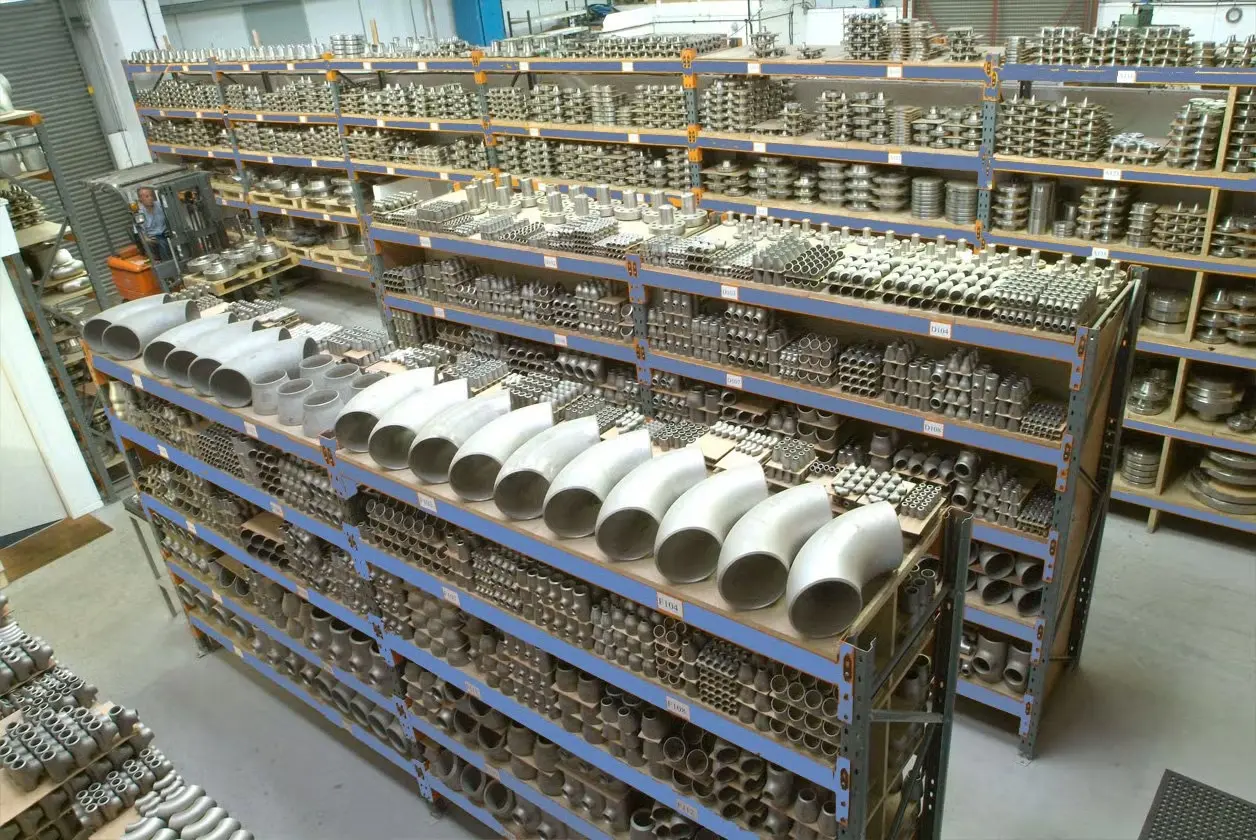
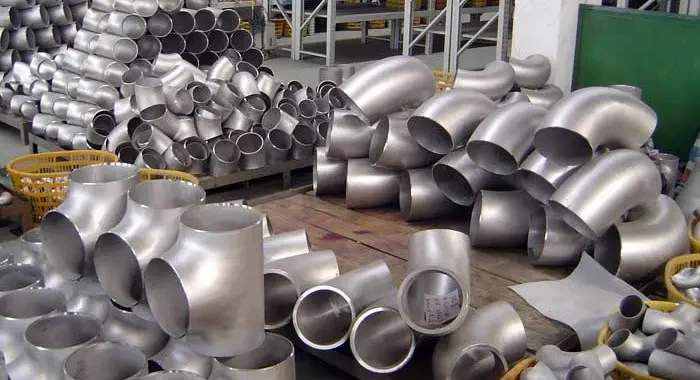
Elbows, tees, reducers, caps, stub ends, forged fittings and branch outlets in stainless steel, duplex, carbon steel, alloy steel and nickel alloys — with the matching grades, dimensions and tolerances you need to specify them.
We supply butt weld fittings, forged socket weld and threaded fittings, and branch outlets in stainless steel, duplex, super duplex, carbon steel and alloy steel — and in nickel alloys, titanium and copper-nickel for the lines that need them.
Fittings are supplied in the same grade and schedule as the pipe they join, so the whole line comes with one set of documents. Every fitting is stamped with its grade, size and heat number and supplied with a mill test certificate to EN 10204 Type 3.1 or 3.2. When your project needs independent verification, inspection by your nominated agency is carried out before dispatch.
The end connection decides the size range, the pressure the joint can take and how it is made on site. Most lines use butt weld fittings, with socket weld and threaded fittings on small bore.
Bevelled ends welded right through the wall. The joint is as strong as the pipe, with a smooth bore. Standard for NPS 2 and above, and available from NPS 1/2.
Standards: ASME B16.9 · MSS SP-43 · bevels to B16.25The pipe slides into a socket and is fillet welded. Easy to align, with no bevelling. A small gap is left at the bottom of the socket to allow for weld shrinkage.
Standards: ASME B16.11 · NPS 1/8 to 4 · Class 3000, 6000, 9000Screwed together on tapered threads, with no welding. Quick to install and take apart, for small-bore utility, instrument and low-pressure lines.
Standards: ASME B16.11 · NPT to B1.20.1 or BSP · Class 2000, 3000, 6000Fittings change direction, split or combine flow, change size and close the line. These are the shapes we supply, grouped by how they connect.
Turns the line through a right angle. Long radius is the default.
A half turn, for offsets and angled runs.
Reverses flow — heater coils and heat-exchanger loops.
Splits or joins flow with the branch the same size as the run.
A tee with a smaller branch, in one fitting.
Four-way connection, for fire water and utility headers.
Reduces size on a common centre line — vertical lines.
One flat side — pump suctions and drained lines.
Closes the end of a line, welded on.
Used with a lap joint flange, so the flange can be carbon steel.
Forged change of direction for small-bore lines.
Equal and reducing, for small-bore branches.
Four-way forged connection.
Joins two lengths of pipe end to end.
Welded onto a pipe or vessel to make a small branch.
Closes the end of a small-bore line.
A joint that can be taken apart without cutting the pipe.
Reduces a threaded connection by one or more sizes.
Closes a threaded opening.
Fits into a socket weld fitting to take a smaller pipe.
Butt weld branch, welded onto the run pipe.
Socket weld branch for small-bore take-offs.
Threaded branch for instruments and vents.
Branch on the outside of an elbow — thermowells.
A 45° lateral branch on a straight run.
A one-piece outlet and nipple for drains and vents.
A short length of pipe with plain or threaded ends.
A forged reducer between a larger and a smaller pipe.
A forged closure for the end of a line.
Bent from pipe on a large radius, for pigging lines.
An elbow is sized by the pipe it joins and by how tightly it turns. The centre-to-end dimension, A, is what your piping designer uses to lay out the line.
Each material has one specification for butt weld fittings, one for forged fittings and one for pipe. Choose a family to see the grades that belong together.
Wrought fittings to ASTM A403 match A312 pipe grade for grade. Light-wall fittings for Sch 5S and 10S pipe are made to MSS SP-43 and marked CR instead of WP.
| Grade | Butt weld | Forged | Pipe | Where it is used |
|---|---|---|---|---|
| 304 / 304L | WP304 / WP304L | F304 / F304L | TP304 / TP304L | General process, water and food lines. |
| 304H | WP304H | F304H | TP304H | High-temperature service above 525 °C. |
| 316 / 316L | WP316 / WP316L | F316 / F316L | TP316 / TP316L | Chemical, pharmaceutical and coastal plants. |
| 317L | WP317L | F317L | TP317L | Pulp, paper and flue-gas service. |
| 321 / 321H | WP321 / WP321H | F321 / F321H | TP321 / TP321H | Stabilised for 400–800 °C service. |
| 347 | WP347 | F347 | TP347 | Refinery and high-temperature steam lines. |
| 310S | WP310S | F310 | TP310S | Furnace and heat-treatment piping. |
| 904L | WP904L | F904L | N08904 | Sulphuric and phosphoric acid lines. |
Wrought duplex fittings to ASTM A815 carry the UNS number in the grade. Forged fittings use the A182 F-number.
| Grade | Butt weld | Forged | Pipe | Where it is used |
|---|---|---|---|---|
| Duplex 2205 (S31803) | WPS31803 | F51 | A790 S31803 | Chemical, offshore and desalination piping. |
| Duplex 2205 (S32205) | WPS32205 | F60 | A790 S32205 | As S31803, with tighter chemistry. |
| Super Duplex 2507 | WPS32750 | F53 | A790 S32750 | Seawater and high-chloride lines. |
| Super Duplex S32760 | WPS32760 | F55 | A790 S32760 | Seawater, firewater and sour service. |
Choose the carbon steel grade by service: A234 for general and high-temperature lines, A420 for low temperature, and A860 for high-yield line pipe.
| Service | Butt weld | Forged | Pipe | Where it is used |
|---|---|---|---|---|
| General & high temperature | A234 WPB | A105 | A106 Gr. B · A53 Gr. B | The standard carbon steel fitting for process and utility lines. |
| Higher strength | A234 WPC | A105 | A106 Gr. C | Higher-strength carbon steel lines. |
| Low temperature, to −46 °C | A420 WPL6 | A350 LF2 | A333 Gr. 6 | Impact-tested fittings for cold service. |
| Low temperature, to −101 °C | A420 WPL3 | A350 LF3 | A333 Gr. 3 | 3½ % nickel steel for colder service. |
| High-yield line pipe | A860 WPHY 42 – 70 | A694 F42 – F70 | API 5L X42 – X70 | Oil and gas transmission lines. |
Chromium-molybdenum fittings for high-temperature steam and refinery lines. The WP grade matches the P grade of the pipe.
| Composition | Butt weld | Forged | Pipe | Where it is used |
|---|---|---|---|---|
| 5Cr – ½Mo | A234 WP5 | A182 F5 | A335 P5 | Refinery lines with hot sulphur-bearing streams. |
| 9Cr – 1Mo | A234 WP9 | A182 F9 | A335 P9 | Higher-temperature refinery and heater piping. |
| 1¼Cr – ½Mo | A234 WP11 | A182 F11 | A335 P11 | Steam lines and headers. |
| 1Cr – ½Mo | A234 WP12 | A182 F12 | A335 P12 | Boiler and steam piping. |
| 2¼Cr – 1Mo | A234 WP22 | A182 F22 | A335 P22 | High-pressure steam and hydrogen service. |
| 9Cr – 1Mo – V | A234 WP91 | A182 F91 | A335 P91 | Main steam and hot reheat lines in power plants. |
Wrought nickel-alloy fittings are made to ASTM B366, and forged fittings to B564, which identifies the alloy by its UNS number.
| Alloy | Butt weld | Forged | Pipe | Where it is used |
|---|---|---|---|---|
| Monel 400 | B366 WPNC | B564 N04400 | B165 | Seawater and hydrofluoric acid lines. |
| Inconel 600 | B366 WPNCI | B564 N06600 | B167 | High-temperature and caustic service. |
| Inconel 625 | B366 WPNCMC | B564 N06625 | B444 | Seawater, flue-gas and chemical lines. |
| Incoloy 800 / 800H | B366 WPNIC / WPNIC10 | B564 N08800 / N08810 | B407 | Furnace and petrochemical piping. |
| Incoloy 825 | B366 WPNICMC | B564 N08825 | B423 | Sulphuric and phosphoric acid lines. |
| Hastelloy C276 | B366 WPHC276 | B564 N10276 | B622 | Wet chlorine and mixed-acid service. |
| Alloy 20 | B366 WP20CB | B462 N08020 | B729 | Sulphuric acid handling. |
Titanium fittings for seawater, chlor-alkali and chemical plant, matched to seamless and welded titanium pipe.
| Grade | Butt weld | Forged | Pipe | Where it is used |
|---|---|---|---|---|
| Grade 2 | B363 WPT2 | B381 F2 | B861 / B862 Gr. 2 | General corrosion service and seawater lines. |
| Grade 7 | B363 WPT7 | B381 F7 | B861 / B862 Gr. 7 | Reducing acids. |
| Grade 12 | B363 WPT12 | B381 F12 | B861 / B862 Gr. 12 | Crevice-corrosion resistance at higher temperature. |
Copper-nickel fittings for seawater and firewater systems on ships and offshore platforms; copper fittings for plumbing, medical gas and refrigeration.
| Alloy | UNS | Fittings | Pipe | Where it is used |
|---|---|---|---|---|
| Copper-Nickel 90/10 | C70600 | EEMUA 146 | EEMUA 144 · B466 | Seawater cooling and firewater lines. |
| Copper-Nickel 70/30 | C71500 | EEMUA 146 | B466 | Higher-velocity seawater service. |
| Copper | C12200 | ASME B16.22 | B88 · B280 | Plumbing, medical gas and refrigeration. |
Aluminium butt weld fittings for cryogenic, chemical and lightweight piping.
| Alloy | UNS | Fittings | Pipe | Where it is used |
|---|---|---|---|---|
| 6061 | A96061 | B361 WP6061 | B241 6061 | General structural and process piping. |
| 6063 | A96063 | B361 WP6063 | B241 6063 | Architectural and low-pressure lines. |
| 5083 | A95083 | B361 WP5083 | B241 5083 | Marine and cryogenic service. |
Swipe the table sideways to see every column
The chemistry of each fitting grade follows the matching pipe grade; see the Pipes & Tubes page. For other families and product forms, see Materials & Grades.
Every fitting is marked with what it is and how it was made. This is how to read a typical stainless steel elbow, and what to check against your order and the certificate.
Composition limits in percent by weight for the carbon and alloy steel fitting grades. A single figure is a maximum; a range shows minimum and maximum. Stainless, duplex and nickel fitting grades follow the matching pipe grade.
| Grade | C | Mn | P | S | Si | Cr | Mo | Others |
|---|---|---|---|---|---|---|---|---|
| Carbon steel · butt weld | ||||||||
| A234 WPB | 0.30 | 0.29 – 1.06 | 0.050 | 0.058 | 0.10 min | 0.40 | 0.15 | Ni 0.40 · Cu 0.40 · V 0.08 |
| A234 WPC | 0.35 | 0.29 – 1.06 | 0.050 | 0.058 | 0.10 min | 0.40 | 0.15 | Ni 0.40 · Cu 0.40 · V 0.08 |
| A420 WPL6 | 0.30 | 0.60 – 1.35 | 0.035 | 0.040 | 0.15 – 0.40 | 0.30 | 0.12 | Ni 0.40 · Cu 0.40 · V 0.08 · Nb 0.02 |
| Carbon steel · forged | ||||||||
| A105 | 0.35 | 0.60 – 1.05 | 0.035 | 0.040 | 0.10 – 0.35 | 0.30 | 0.12 | Ni 0.40 · Cu 0.40 · V 0.08 |
| A350 LF2 | 0.30 | 0.60 – 1.35 | 0.035 | 0.040 | 0.15 – 0.30 | 0.30 | 0.12 | Ni 0.40 · Cu 0.40 · V 0.08 · Nb 0.02 |
| Alloy steel · forged | ||||||||
| A182 F11 Cl. 2 | 0.10 – 0.20 | 0.30 – 0.80 | 0.040 | 0.040 | 0.50 – 1.00 | 1.00 – 1.50 | 0.44 – 0.65 | – |
| A182 F22 Cl. 3 | 0.05 – 0.15 | 0.30 – 0.60 | 0.040 | 0.040 | 0.50 | 2.00 – 2.50 | 0.87 – 1.13 | – |
| A182 F91 | 0.08 – 0.12 | 0.30 – 0.60 | 0.020 | 0.010 | 0.20 – 0.50 | 8.00 – 9.50 | 0.85 – 1.05 | V 0.18 – 0.25 · Nb 0.06 – 0.10 · N 0.030 – 0.070 |
Swipe the table sideways to see every element
Values are shown for reference and follow the specifications named in the table. Limits are revised from time to time, so the edition of the specification on your order, and the mill test certificate supplied with the material, always govern. Butt weld alloy grades A234 WP5 to WP91 follow the A335 pipe chemistry on the Pipes & Tubes page.
A fitting must be at least as strong as the pipe it joins, so its grade follows the pipe. The second chart shows how the length of a long radius elbow grows with pipe size.
MPa · butt weld and forged fitting grades
Duplex fittings carry more than twice the load of 316L, which is why duplex lines can use a lighter schedule.
mm · dimension A to ASME B16.9
From NPS 3 upward, A is 1.5 × NPS in inches. The full table for every fitting is in the dimension chart below.
| Grade | Specification | Tensile strength MPa | Yield strength, min MPa |
|---|---|---|---|
| Stainless steel | |||
| WP304 · WP316 · WP321 · WP347 | ASTM A403 | 515 min | 205 |
| WP304L · WP316L | ASTM A403 | 485 min | 170 |
| F304 · F316 · F321 · F347 | ASTM A182 | 515 min | 205 |
| F304L · F316L | ASTM A182 | 485 min | 170 |
| Duplex & super duplex | |||
| WPS31803 · F51 | ASTM A815 / A182 | 620 min | 450 |
| WPS32205 · F60 | ASTM A815 / A182 | 655 min | 450 |
| WPS32750 · F53 | ASTM A815 / A182 | 800 min | 550 |
| WPS32760 · F55 | ASTM A815 / A182 | 750 min | 550 |
| Carbon steel | |||
| WPB | ASTM A234 | 415 – 585 | 240 |
| WPC | ASTM A234 | 485 – 655 | 275 |
| WPL6 | ASTM A420 | 415 – 585 | 240 |
| WPHY 52 | ASTM A860 | 455 min | 360 |
| A105 | ASTM A105 | 485 min | 250 |
| LF2 Cl. 1 | ASTM A350 | 485 – 655 | 250 |
| Alloy steel | |||
| WP5 · WP9 · WP11 · WP22, Cl. 1 | ASTM A234 | 415 – 585 | 205 |
| WP91 | ASTM A234 | 585 – 760 | 415 |
| F11 Cl. 2 | ASTM A182 | 485 min | 275 |
| F22 Cl. 3 | ASTM A182 | 515 min | 310 |
| F91 | ASTM A182 | 585 min | 415 |
Swipe the table sideways to see every column
Actual test results, including elongation and hardness, are reported on the mill test certificate.
Centre-to-end and overall dimensions to ASME B16.9, in mm. The wall thickness of each fitting matches the schedule of the pipe; see the pipe schedule chart.
| NPSinch | ODmm | 90° LR elbowA | 90° SR elbowA | 45° LR elbowB | 180° LR returnO, centre to centre | TeeC, run · M, branch | ReducerH, length | CapE, length |
|---|---|---|---|---|---|---|---|---|
| 1/2 | 21.3 | 38 | – | 16 | 76 | 25 | – | 25 |
| 3/4 | 26.7 | 38 | – | 19 | 57 | 29 | 38 | 25 |
| 1 | 33.4 | 38 | 25 | 22 | 76 | 38 | 51 | 38 |
| 1 1/4 | 42.2 | 48 | 32 | 25 | 95 | 48 | 51 | 38 |
| 1 1/2 | 48.3 | 57 | 38 | 29 | 114 | 57 | 64 | 38 |
| 2 | 60.3 | 76 | 51 | 35 | 152 | 64 | 76 | 38 |
| 2 1/2 | 73.0 | 95 | 64 | 44 | 190 | 76 | 89 | 38 |
| 3 | 88.9 | 114 | 76 | 51 | 229 | 86 | 89 | 51 |
| 3 1/2 | 101.6 | 133 | 89 | 57 | 267 | 95 | 102 | 64 |
| 4 | 114.3 | 152 | 102 | 64 | 305 | 105 | 102 | 64 |
| 5 | 141.3 | 190 | 127 | 79 | 381 | 124 | 127 | 76 |
| 6 | 168.3 | 229 | 152 | 95 | 457 | 143 | 140 | 89 |
| 8 | 219.1 | 305 | 203 | 127 | 610 | 178 | 152 | 102 |
| 10 | 273.0 | 381 | 254 | 159 | 762 | 216 | 178 | 127 |
| 12 | 323.8 | 457 | 305 | 190 | 914 | 254 | 203 | 152 |
| 14 | 355.6 | 533 | 356 | 222 | 1067 | 279 | 330 | 165 |
| 16 | 406.4 | 610 | 406 | 254 | 1219 | 305 | 356 | 178 |
| 18 | 457 | 686 | 457 | 286 | 1372 | 343 | 381 | 203 |
| 20 | 508 | 762 | 508 | 318 | 1524 | 381 | 508 | 229 |
| 24 | 610 | 914 | 610 | 381 | 1829 | 432 | 508 | 267 |
Swipe the chart sideways to see every fitting
Reducer length H is the same for every reduction from a given large end. Cap length E is for standard wall; caps for heavier walls are longer. Sizes above NPS 24, up to NPS 48, are supplied on request.
| Class | Socket weld fittings use with pipe | Threaded fittings use with pipe | Size range NPS |
|---|---|---|---|
| 2000 | – | Sch 80 · XS | 1/8 – 4 |
| 3000 | Sch 80 · XS | Sch 160 | 1/8 – 4 |
| 6000 | Sch 160 | XXS | 1/8 – 4 |
| 9000 | XXS | – | 1/2 – 2 |
Per ASME B16.11. The class is a designation, not a pressure in psi; the pressure rating of the joint is that of the matching pipe.
Dimensional tolerances for butt weld fittings to ASME B16.9, and the standard bevel that prepares each end for welding.
| Item | Tolerance |
|---|---|
| Outside diameter at the bevel | |
| NPS 1/2 to 2 1/2 | +1.6 / −0.8 mm |
| NPS 3 to 4 | ±1.6 mm |
| NPS 5 to 8 | +2.4 / −1.6 mm |
| NPS 10 to 18 | +4.0 / −3.2 mm |
| NPS 20 to 24 | +6.4 / −4.8 mm |
| Inside diameter at the end | |
| NPS 1/2 to 2 1/2 | ±0.8 mm |
| NPS 3 to 8 | ±1.6 mm |
| NPS 10 to 18 | ±3.2 mm |
| NPS 20 to 24 | ±4.8 mm |
| Wall & length | |
| Wall thickness | 87.5 % of nominal, min |
| Centre to end, A · B · C · M | ±2 mm |
A starting point for choosing the type of fitting. The material follows the pipe; the fitting type follows the size, the service and how the line is built.
| Situation | Typical choice | Why |
|---|---|---|
| Process lines, NPS 2 and above | Butt weld · B16.9 | Full-strength welded joint with a smooth, crevice-free bore. |
| Small-bore lines at high pressure | Socket weld · Class 3000 / 6000 | Easy fit-up with no bevelling; strong fillet-welded joint. |
| Utility, instrument & low-pressure lines | Threaded · Class 2000 / 3000 | No welding. Not suited to cyclic, toxic or flammable service. |
| Thin-wall stainless, Sch 5S & 10S | MSS SP-43 · CR grades | Light-wall fittings made to match light-wall pipe. |
| Normal change of direction | 90° / 45° LR elbow | Gentle turn with low pressure drop and wear. |
| Tight spaces | 90° SR elbow | Shorter centre-to-end, at the cost of more pressure drop. |
| Pigging & slurry lines | 3D / 5D bend | Large radius lets pigs pass and reduces erosion. |
| Pump suction reduction | Eccentric reducer, flat side up | No air pocket can form at the top of the line. |
| Small branch on a large header | Weldolet · sockolet · threadolet | Cheaper and lighter than a reducing tee. |
| Flanged joints in costly alloy | Stub end + lap joint flange | Only the stub end is alloy; the flange can be carbon steel. |
| Joints that are opened often | Union | Can be taken apart without cutting the pipe. |
Swipe the table sideways to see every column
This guide is for orientation only. The choice of fitting and material depends on the full service conditions and the governing piping code, and remains the responsibility of the design engineer.
Every fitting is traceable to its heat number and leaves with its mill test certificate. These tests are arranged when your order calls for them.
The bend radius. A long radius (LR) elbow bends on a centre-line radius of 1.5 times the nominal pipe size, a short radius (SR) elbow on 1.0 times. LR elbows are the default in process piping because the flow turns more gently, with less pressure drop and wear. SR elbows are used where space is tight. See the elbow drawing.
They describe how the fitting was made. S is seamless. W is welded. WX is welded with all welds radiographed. WU is welded with all welds ultrasonically tested. For example, A403 WP316L-S is a seamless 316L stainless fitting and A403 WP316L-WX is a welded one with fully radiographed welds. See reading a marking.
Yes. A butt weld fitting is ordered in the same nominal size and schedule as the pipe it is welded to, so the walls line up at the weld. The fitting grade should also match the pipe grade, for example A403 WP316L with A312 TP316L pipe.
Match the class to the pipe schedule. Under ASME B16.11, Class 3000 socket weld fittings go with Schedule 80 pipe, Class 6000 with Schedule 160 and Class 9000 with XXS. For threaded fittings, Class 2000 goes with Schedule 80, Class 3000 with Schedule 160 and Class 6000 with XXS.
An eccentric reducer keeps one side of the pipe straight. At a pump suction it is installed flat side up, so no air pocket can collect at the top of the line. In pipe racks it is often installed flat side down so the line drains, or to keep the bottom of pipe at one level on its supports.
Every lot is supplied with a mill test certificate to EN 10204 Type 3.1 or 3.2, traceable to the heat number marked on each fitting, along with any additional test reports ordered, such as radiography, PMI or intergranular corrosion tests. When third-party inspection is called for, the agency's inspection release note is included. More on our quality & inspection page.
Pipe, flanges, valves and fasteners in matching grades, so the whole line comes from one supplier with one set of documents.
Send the fitting list with sizes, schedules and grades. We will confirm availability and quote, with the mill test certificate and inspection you need.